28 May 2014

The ICC and the Africa problem

Picking up from last week, I am, as in so many things, late to this party.

The ICC is currently looking into allegations of war crimes in eight countries, all in Africa. Four of the investigations are the result of requests by Uganda, the DRC, the Central African Republic and Mali. The UNSC asked for two others, in Libya and Sudan. In a way, this makes sense. After all, Africa accounted for 24% of global direct conflict deaths from 2004-2007 (this is from the Geneva Declaration report on the global burden of armed violence, and it is completely and utterly worth your time to read). The Middle East and Asia, however, accounted for around 60% (given the timeframe, we can fairly safely assume that this was the Iraq war, and by all that’s holy you have to know the ICC wasn’t going to touch that with a ten foot pole). Moreover, from 2004-2009, the countries with the highest rates of violent deaths annually were El Salvador, Iraq, Jamaica, Honduras, and Colombia, and the ICC hasn’t even bothered to begin investigations (I’m not just blowing smoke – there is a correlation between homicide rates and efficacy of a given criminal justice system).

In fact, the ICC has only ever prosecuted Africans, a fact which has resulted in some raised eyebrows. Some might argue (reasonably, I think) that if you only step in where crimes are the worst, and then only when the state either does not have the power to handle it themselves or to tell you to bugger off (which is more or less what Colombia has done), it lends itself to a certain section of the globe. Others might applaud the Court for focusing on the plight of African victims and survivors when so many others prefer to overlook them (insert your own Dark Continent reference here). But others see something more nefarious at work – a kind of neo-colonialism, a standard of global justice that is reserved for Africa alone.

And Africa, which as the continent boasts more signatories of the Rome Statue than any other – 34 – is fighting back. The AU actually went so far as to urge member states not coöoperate with the ICC in detaining Sudan’s Omar al Bashir, a clear violation of Rome Statute. Of course, several African states ignored the call, apparently uninterested in aiding and abetting a pariah of the international community. South African, for example, threatened him with arrest if he attended the inauguration of President Jacob Zuma, while Malawi refused him entrance to an AU summit, and Kenya – clearly, some time ago – blocked him from attending a regional summit. He even cancelled or hastily abandoned trips to Zambia, CAR, and Nigeria for fear of being apprehended. Even so, hackles are raised. Ethiopia’s PM recently accused the court of ‘race hunting’, though I am not totally clear on what that means.

Rwanda has been a particularly outspoken opponent of the Court, which likely stems from the government’s frosty relations with ICTR. This Rwandan antipathy is a bit unwarranted, as they are a non-signatory and the ICC, not being the ICTR, has no jurisdiction over the RPF’s counter-genocide, not that the Tribunal has managed to do much about it in the past 20 years. Where, then, is the beef? A good question; it can be found in the accusations that Rwanda has been backing M23, CNDP, and whatever other Congolese insurgency most fits their whim at the moment. The DRC is quite an active signatory, actually, which does give the Court jurisdiction over any Rwandan official they suspect of meddling with atrocities committed across the border (so, several). There’s even some pretty solid precedent here in the conviction of conviction of Charles Taylor in 2012 for supporting the RUF.

If you happen to be thinking that the accusations of regional/racial bias seem to be tossed around by those most likely to face investigation, you wouldn’t be alone. Which brings me to the latest round of attacks being level at the ICC, this time by a state that was previously among its staunchest defenders. In my last post, I hinted at and talked around this new development, so let’s finally deal with the Kenyatta trial head-on. It’s now been delayed – for the third time – until October, though when/if it finally gets underway, it will mark the first time a sitting head of state has been tried before the court. Draaaaama!

Let me explain – no, there is too much. Let me sum up: President Uhuru Kenyatta is charged with inciting the ethnic violence surrounding the 2007 elections (remember those, when 1,200 people were killed in one of Africa’s most stable states? Fun times were had by all). It’s not just Kenyatta, but also his deputy, William Ruto, and radio journalist Josiah Sang, who have been charged. Last September, the AU asked that the ICC refer the cases to local courts, noting that Kenyan constitutional reforms from 2010 – so, reforms instituted by the government of the accused, after the warrants were issued – were sufficient to allow for a national mechanism to investigate and prosecute the cases. The ICC demurred; Kenya cried violation of sovereignty and lobbied the member-states of the AU to withdraw en masse from the ICC a month later.

Clearly, that did not occur, but the handing of this case has exemplified the stickiness of the Court’s situation, and its outcome likely to do so doubly, mired as it is in all manner of ethnic politics in Kenya. The president and his deputy are from two of the largest tribes, most historically prone to clashing with one another. Right now, in a delicate and frankly unlikely coalition – the Jubilee Alliance. “But the outcome of the ICC cases, especially a mixed verdict in which one of the two leaders is convicted and the other is acquitted…will severely test the durability of their coalition. The breakup of the Jubilee Alliance could have far-reaching consequences for peace and security in the Rift Valley.”

While it is impossible to separate the trial from local politics, let’s try and keep a macro lens on the situation. In that sense, it’s a question of Imperialism versus Impunity. In the Imperialism corner, wearing righteous indignation, is the Kenyan government, which has said that the trial is a “farcical pantomime, a travesty that adds insult to the injury of victims…It stopped being the home of justice the day it became the toy of declining imperial powers.” They have also repeatedly opined that the trail is unfairly distracting Kenyatta from governing the state. In the other corner, wearing high-handedness, is the ICC and it’s supports arguing that only the court has the necessary level of impartiality to “break the deeply entrenched and pervasive culture of impunity”. Unfortunately for the challenger, my money is with the Court in this particular fight (because I’m sure that’s what they were worried about). Kenya’s judiciary is not exactly renown for its independence from the executive branch, which appoints it. Further, Kenyatta and Ruto somewhat undercut their own charge of imperialism by hiring Western lawyers and PR consultants to manage their defence in both the legal and public spheres.

What really sends this fight in the ICC’s favour, though? How the case came before the Court in the first place. For all intents and purposes, the ICC was called in as the result of an AU-created mediation panel led by former UNSG Kofi Annan, and only after the bill to establish a local tribunal, following the recommendations of the panel, was defeated in the Kenyan parliament twice. At the time, Kenyan politicians including Ruto said they preferred going to the Hague, and Kenyatta himself endorsed Annan’s decision to present his evidence to the ICC prosecutor. They took a gamble that the ICC would not the stones to take on sitting heads of government, and they might have lost the farm.

Frankly, this is something of a damned if you do/n’t scenario for the ICC. A conviction will serve as a self-fulfilling prophecy for those who accuse the court of ‘race hunt’ and selective justice targeting Africans. If all parties are acquitted or the case dismissed, possibly due to non-cooperation by the defendants (see getting it postponed three times) or witnesses recanting or vanishing (which challenges the prosecutor is meeting through the creation of a witness protection program and the creation of a new rule that allow sworn testimony to be considered even in the event of a witness’ disappearance or death), it will be proof positive of the Court’s inability to make the hard charges stick or ensure justice for the victims of violence.

Uganda did fairly recently agree to hand some people over to the ICC, so that’s a nice affirmation, I guess. They’re M23 types, which begs the question why didn’t they just head out for Rwanda? Wrong neighbour, fellas.

I’ll wrap up for the moment with a few other, non-African (mostly) side notes:

Palestine, which has lately been enjoying stretching the bounds of its official observer status at the UNGA, has been quite amusing vis-à-vis the Court. In a savvy move, it opted to not sign the Rome Convention, even when signing on to a wealth of other international. Any and all of these actions were, of course, opposed by the US and Israel (because having Palestine affirm the rights of the child or join the international community in standing against torture or war crimes is a terrible thing. Sometimes, I really hate the US), but joining the Court would have opened Israeli soldiers to its oversight, and even Palestine recognised that as a bridge too far.

Meanwhile, the UNHCR (the position, not the UN organ, though I’m not sure you can fully separate the two) has expressed a desire to refer North Korea leadership to the ICC, saying that “security chiefs and possibly even Supreme leader Kim Jong Un himself should face international justice for ordering systematic torture, starvation, and killings comparable to Nazi-era atrocities.” China, as you can imagine, was not amused.

Finally, let’s come back around to international justice and the DRC with this interesting read from the BBC. It’s a bit dated – the anniversary has passed, but, hell, this whole post is pretty dated, and surprisingly genocide-themed. Well, given the subject matter, I suppose it’s not so surprising. But still.

Oh, and since my colleagues made that rather tasteless joke about calling Kony? The LRA has started attacking again. The head nurse at one of our clinics (one I visited, actually – Asa) was kidnapped last month and we haven’t heard from or about him since. Even so, the donors have left Ango, and they’re not coming back. It looks like our base will likely be closed within a year, just as those of all the other NGOs. The last vestiges of international concern for an area so destitute that one can only pay for her C-section with a pineapple are drying up. Maybe it’s not the ICC that has an Africa problem – it’s everybody else.

23 May 2014

ICC and the problem with the globalisation of justice

This topic has been kicking around my brain for the last few months. Really, ever since Kenya tried to engineer a pull-out of ICC by the entire AU, mid-October last (which we will get to). Even before that, though, spurred by a somewhat nihilistic running joke among my team after yet another donor refused to continue funding programming in a remote region of Province Orientale. Despite the obvious deprivation of the area, donor after donor has retracted their funding with the excuse that the area can no longer be considered an emergency, thereby prompting the project manager to blackly opine that they wished Kony would attack again. Not enough displacement? What if we texted the LRA? You guys rape and pillage, and we’ll clean up after. We might end up in front of the ICC, but we’ll have beaten Syria’s funding numbers (our HQ is forever comparing us – unfavourably – to the programmes in Syria and South Sudan, who seem to be securing funding hand over fist)! At any rate, the ICC came to mind yet again a few weeks ago with the Congo conviction (more on that, too), and I’m now finally getting around to thinking about it in greater depth. This, of course, does not mean that I have any more clarity on the topic, but only that I am – hopefully – slightly more articulate that I otherwise might be.

I am, for my sins, an intuitionalist. I continue to believe that the good of the ICC, UN, and other international bodies outweighs their ills, despite considerable first-hand evidence to the contrary (I also feel that the general incompetence and negligence of the UN is its most unforgivable sin, rather than those Congress tends to accuse it of. Some sort of vast, complicated conspiracy in which it’s trying to take away our guns or teach our children Esperanto would be so much more interesting and engaging, but that’s a conversation for another day). On balance, I think the very fact of the ICC’s existence is a triumph for the international community. Unfortunately, existing alone, while necessary, is not sufficient for this or any court to remain a success. One also must do, not simply be. So, it is with some trepidation that I try to approach the topic of why the ICC is hot mess. Because it is, make no mistake.

As a bit of background, the International Criminal Court was established by the Rome Statute in 2002. There are some 122 (I think) signatories to the statute – 122 nations in the world recognize the legitimacy of the ICC. Optimistically, the Court is one of last resort and thought to beyond the reach of the corruption and incompetence of local courts. That is, it’s a sort of stop-gap, when local judiciaries cannot or will not function. This could be because the state is such a disaster or because the trauma associated with the crime is so immense that the state itself cannot try the alleged perpetrator (perhaps because there are too many – like the Rwandan genocidaiers – or too highly placed – think Omar al-Bashir).

However, it is only intended to address a very specific subset of issues, ones that are supposedly so heinous that they warrant the involvement of all of the peoples of the world. These include war crimes, genocide, crimes against humanity, and a very select set of human rights abuses, whether committed during war or peace time. The premise that, for some crimes, the global need for justice outweighs, or is at least on par with, that of the direct victims is interesting, but might well be shenanigans.

At any rate, the ideas underpinning the Court are all well and good, of course, but (as is the case with many an international body) things become a bit trickier when you try to put them in practice. I suppose that the misadventure that is the ICC should have been seen a mile away and half a century ago, what when a similar institution did not emerge during the halcyon days of international institutionalism following WWII. Indeed, one would have expected that the Nuremburg and Tokyo trials would have naturally led to an internal court being made permanent, but it took a good 50+ years and several more horrifying instances of mass violence (specifically the Yugoslav war and Rwandan genocide, the latter which is supposed to shutter next year has cost the international community more than 1.7 billion USD and only managed to indict 92 people in 20 years. One case dragged out for 10 years. I would love to get more into the ICTR vs. gacaca process, with tremendous differences in price tag and timeline, as well as potential for witnesses getting iced, but another time, perhaps) with associated, internationally-run tribunals. Where one might have expected that half-century of reflection to turn out a high-functioning, well-informed product, one would be charmingly naïve.

Let’s start with the basics. All criminal justice systems, no matter their scope or efficacy, face a similar subset of issues. Evidence collection. Witness tampering. Due process. Insufficient funds. All that jazz. The ICC has all of these, but with crimes that are really, really difficult to convict on and with even fewer resources. It’s the Order without the Law, but on a global scale. Let’s take a gander at the Congo trial I mentioned earlier. By way of a recap, one Germain Katanga (former FPRI commander) was found guilty of war crimes for his involvement in a 2003 massacre in Bogoro (this is where we go to the waterfalls, when security is good enough. It’s terribly pretty). He is only the second person to be convicted by the ICC since its creation in 2002 (and how’s that for a success rate?!). He was convicted as an accessory (planned and got weapons for, but was not directly involved in) to an attack that killed more than 200 people. “According to the prosecution, the attack happened early in the morning and some villagers were shot while they slept, while others were cut up with machetes to save bullets.” Lovely. “The judges found that women who survived the massacre had been raped or kept as sex slaves but they did not find enough evidence to convict Katanga of carrying out these crimes.” Proving someone directly ordered his troops to engage in mass rape is a tall order (though you would think his allowing them to take sex slaves would be easier to prove. Did he just shrug and offer to overlook it this one time?), short of an A Few Good Men-style meltdown or outright snitchery. Which happens so very often within military units, even of the para-military persuasion. A much more likely scenario, especially among rebel groups, is that commanders obliquely encourage such actions among their troops by dehumanizing rival tribes or civilian targets.

I should not that it’s not always a question of outright witness tampering or intimidation that leads them to recant or refuse to work with ICC investigators. Indeed, the former ICTR prosecutors noted that many witnesses clammed for their won mental health. In the absence of comprehensive PTSD treatment, witnesses intentionally forgot some of the worst of the genocide so that they were better able to survive its aftermath.

In Afghanistan (the prospect of cases in Afghanistan makes the coalition deeply unhappy), the ICC prosecutor, Ms. Fatou Bensouda, has cited difficulties due to security considerations (imagine that) and a lack of cooperation by key sources. When your raison d’être is to provide justice to places where there is no functioning legal system (which is often collateral damage during a civil war) or where corruption and intimidation are rife (thereby lessening the possibility of forthcoming witnesses), you rather seemed doomed to failure, no? Referrals from the Security Council – while rare – are also intensely problematic, as they allow a state(s) that has not yet ratified the Rome Statue to subject another state to its punitive oversight. The lack of follow-up enforcement by the SC means arguably even less success with these cases than with those referred by states (we’ll get to the quintessential example of Sudan in a bit).

Indeed, the fact that states who are not party to the Rome Statute (hello, US!) can have a hand in siccing the Special Prosecutor on others raises the question of how the ICC can ensure an equal application of justice. I keep coming back to Congo, not (only) for the obvious reasons, but because it’s such a good case study for these sorts of things. Like the many rebel groups they fight, the FARCD is notorious for use of rape at a weapon and attacks on civilians (which makes sense, because the line between the two – rebel and state soldier – has historically been rather fluid). So when your armed forces have a culture of rape infinitely more dramatic than the one we talk about in the States (which I’m not trying to undercut. I believe that we have a violence against women problem back home, too, but it’s a question of immediacy), who do you target? Individual perpetrators? Unfortunately, that’s no really feasible – a single instance of rape, while horrific, does not, one imagines, rise to the level of a crime against humanity. But then how do you go after a commander for all of the rapes, even if he didn’t commit one himself? How do you prove that kind of institutional culpability, especially when it didn’t even happen with our boy Germain, who presumably lacks the protection one might garner by being a member of the formal security structure? I mean, just try to imagine the ICC attempting to prosecute the torture and abuse at Abu Ghraib. Going after the faces from the photos, wearing cocking grins as their victims lie at their feet, would be satisfying, to be sure, but would hardly address the underlying issue that commanders had – even unintentionally (I’m so sure) – allowed a conviction to develop that such impunities would not only be tolerated, but venerated. Even if, as the US military claimed in that instance, it was just a ‘few bad apples’ acting out, does not their command structure bear some responsibility for their actions? It would rather seem to be the entire point of the military hierarchy, actually. In that case, is negligence in the face of a crime against humanity enough of a charge for prosecution on a global stage?

Of course, if you follow most episodes of institutional violence far enough, you generally end up at the same place: the Head of State. The Rome Statute “However, a central purpose of the ICC is to prosecute government leaders who might otherwise use their positions of power to secure impunity for their crimes.” Rome Statue explicitly affirms that Heads of State or Government shall in no case exempt a person from criminal responsibility.” Indeed, were the ICC to exempt heads of state, could force those in power to double down and morph into President’s for life or the like, and I don’t think that’s what they were going for (I cannot stress this enough – if you want to avoid prosecution, WIN). Of course, actually prosecuting a sitting president/prime minister/despot presents its own unique challenges and backlash, several of which are currently being advanced in Kenya. (Kenyatta, who we will get to in a moment, also using this one).

The relation of the Court to on-going insurgencies is yet another interesting topic, especially in how the possibility of prosecution weighs on leadership. In some instances, such as with Laurent Nkunda, the former leader of the CNDP (predecessors of M23), supporters of the ICC have noted its deterrent effect. In 2007 and 2008, Nkunda reportedly expressed concern that the ICC would target him for prosecution, leading him to attempt to curtail abuses committed by his troops. Even if an immunity agreement could factor into a peace accord, would that not complicate the issue of justice? Additionally, there is also evidence to suggest that the threat of the ICC has driven some insurgent leaders – ahem, Kony – further into the bush and prolonged their activities.

According to Hans-Peter Kaul, a former, I think, ICC Judge, the Court’s overarching problem is its ‘critical dependency on effective cooperation from states, member and non-member alike. The ICC has no executive or police powers of its own, meaning that, by design, it is ‘characterized by the structural weakness that it does not have the competencies and means to enforce its own decisions.’ States, therefore, must be willing the foot the bill for and enforce the arrest warrants of the Court. This is of course somewhat in tension with another intentional design flaw of the court, which is its complementary nature. The ICC only has jurisdiction ‘in and when states which normally would have jurisdiction are either unwilling or genuinely unable to exercise their jurisdiction.’ So…the Court can only act when states are unable to, only the Court never has the capacity to act, and is in fact dependent on states to function. That makes perfect sense. I wonder how it feels to work for an institution that was structurally doomed to failure from the get-go. Talk about a bunch of starry-eyed idealists! And they’re all lawyers! But since when has the almost perfect probability of failure meant that you shouldn’t do a thing that should be done? Full speed ahead, ICC, and damn the torpedoes.

Underpinning the many structural flaws of the Court, though, is a more basic definitional problem: what is a crime against humanity? Let me direct your attention to Latin America, which has the highest murder rates in the world. With only an eighth of the world’s population, it accounts for more than one third of its murders, most of which go unsolved and unpunished. That is BANANAS. At least on the surface, the lion’s share of Latin American states also has functioning judiciaries, but clearly something is going wrong. Where, then, does the ICC fit into this scenario, if indeed it does at all? It would seem beyond absurd to suggest that the ICC should try individual murders, but if mass rape can be a crime, might not the persistent impunity of criminal syndicates and drug cartels also rise to the level of a crime against humanity? The jurisdiction of the court is not nearly as clear cut as would be helpful.

In recognizing these difficulties, does that mean that the ICC should only target those they can reach? Or should it cast a wide net to make a point and hope that someone is game enough to arrest a visiting head of state some day? It doesn’t seem able to answer that question itself, just yet. But as it keeps vacillating between low-level rebels and heads of states, it has been accused of selective prosecution and become ensnared in the tremendously tactile problem of politics. And this gets us back to Kenya and the current kerfluffle of what some have dubbed the ICC’s Africa Problem.

For the moment, however, I have babbled enough with this post that was mostly a series of vexing rhetorical questions I didn’t even attempt to answer. I even failed to address the issue in Kenya, which is what inspired me to write in the first place. For shame! Perhaps the weekend will give me the clarity that months of reflection and free writing have not.

29 April 2014

To infinity and beyond by way of the Inquisition

It’s the Hubble’s 24 year-anniversary (which is a good a reason as any to check out some of its trés spiffy body of work. For an awesomely enthusiastic description of one of the more impressive of those photos, go here. Phil Plait’s child-like joy is infectious). Technically, the telescope’s birthday was earlier this month, but I missed the actual day, so we’re going with anniversary and pretending that 24 is significant in some way. As I remember it, it was a pretty good year, so there’s that. Besides, with some two hundred young women getting kidnapped on the eve of their physics exam in Nigeria, I think that we need to beat back our terrestrial depression with a celebration of the cosmos.

Luckily, there’s been a host of space-related things going on lately, including the potential confirmation of a not-horrible kind of inflation. Very simply, some terribly intelligent people have discovered – get this – ‘ripples in the fabric of space time’ (sweet fancy pants, you mean like a tesseract?) that corroborate a decades-old theory that ‘less than a trillionth of a second after the Big Bang, the universe expanded faster than the speed of light. Tiny ripples in the violently expanding energy field eventually grew into the large-scale structures of the universe.’ This theory apparently explains why our universe is even in shape and temperature (I really wish I was bright enough for a job that called upon me to contemplate the temperature of the heavens).

I love how inflation, like so much else, becomes something deeply cool, if not near miraculous, when you stick it among the stars. Granted, I had but one semester of astrophysics in university, so I don’t really understand what they’re going on about with the gravitational waves and latent energies, and in fact think I prefer seeing this as modern magic. That NYT article even uses a French press to illustrate how the universe has grown in the aftermath of the Big Bang. Coffee and Space? I’m in!

Inflation apparently also posits the existence of the multiverse (seriously, this story has EVERYTHING. Go read it now). Apparently, inflation, once begun, is eternal and will result in the rest of the cosmos continuing to expand, spinning off new universes into infinity, like some everlasting Rube Goldberg machine. So that amazing Hubble photo, with the countless galaxies forming and living and dying that represents but a fraction of our known universe which itself extends some 14 billion light-years? Remember that photo? According to inflation, it is the proverbial grain of dust in some ‘larger cosmos whose extent, architecture, and fate are unknowable’. What glorious magic this is‽ Rather, in the parlance of our time, MIND BLOWN.

Any talk of the multiverse, of course, puts me in mind of phantom tollbooths, gardens of forking paths, evilly bearded Spocks and licentious Kiras (I haven’t seen Doctor Who, but if I had, I’m fairly certain that could come to mind, as well), zany Discworld, godly Narnia, Donnie Darko with its creepy bunny, Red Dwarf, Fringe, and, of course, the ever-delightful Giordano Bruno, Metaphysical Monk.

Wait, who? You’re unfamiliar with the cantankerous Brother Bruno? Well, friend, let me enlighten you. Giordano Bruno was an Italian monk (of Dominican flavour, which is perhaps not the best choice for a progressive thinker with borderline heretical views back in the day. I mean, he wasn’t a Franciscan, but still…) and philosopher in the 16th century. Not, it should be noted, an astronomer, despite his pretty rabid support of Copernican heliocentrism, which he apparently didn’t grasp all that well. What is more interesting about him – and why people still talk about him today – is the thought experiment he conducted with what he did understand.

I won’t go into terrific detail here (as he can be a bit hard to follow at times, and I don’t think that’s entirely due to the questionable calibre of the translations I was reading), but in his On the Infinite Universe and Worlds, published in 1584, Bruno’s thinking went thusly:
1) The earth goes around the sun;
2) The sun is, in fact, a star, rather like all the others we see in the night;
3) Observed reality (that we exist at all) suggests that these other stars also have planets circling them (‘Whatever is an element of the infinite must be infinite also; hence both Earths and Suns are infinite in number’);
4) There is very probably not one, but hundreds of thousands of worlds rather, though not exactly, like our own (‘since it is well that this world doth exist, no less good is the existence of each one of the infinity of other worlds’)

Right awesome, no? But he takes it even further, positing the existence of the multiverse: ‘only verbally is it possible to deny infinite space, as is done by pertinacious fellows. For the rest of space where the universe is not, which is called void, where indeed it is pretended that nothing doth exist, cannot be conceived as without the capacity to contain no less a magnitude than that which it doth contain… for in eternity there is no distinction between being and potential being [nor therefore between action and potential action]’. For all intents and purposes, Bruno claims that the multiverse is simply too great for us puny mortals to comprehend, and so we simply pretend that it is nothingness (this reminds me of one of the Yoga Sutras, which cautions readers against being too self-centered by reminding them that ‘nor do material objects depend upon a single mind, for how could they remain objective to others, if that mind ceased to think of them?’ Said another way, if a tree falls in the forest, it makes a sound whether you’re there or not. I know I always seem to go to the Sutras, but people have been giving me such guff lately about being both a Christian/Catholic and a yogi that it tickles me how very often the two overlap. Great minds, I guess? That, or I’m just a very specific kind of hammer).

But he’s not done there! Our visionary little monk then wanders out beyond the bounds of harmless quackery and into burning-at-the-stake territory. Let’s walk it through:
1) We already agree that other worlds exist and the universe is infinite;
2) All worlds are not created equal, especially in the being saved by Christ sense (‘the virtue of this world is not communicable to any other world…just as my being cannot be communicated to the being of this or of that man’);
3) You know what else is infinite? God (he has this great digression on how, if God is omnipotent, the universe ze created must be likewise – ‘if omnipotence maketh not the world infinite, it is impotent to do so, and if it hath not power to create it infinite, then it must lack vigour to preserve it to eternity’. Take that, haters! He also calls God the universal nature, which I adore);
4) God must therefore be present on all worlds (‘the Supreme Ruler cannot have a seat so narrow, so miserable a throne, so trivial, so scant a court’ as to be limited to one earth alone), and will have saved all worlds through an infinite number of Messiahs born of all these different men.

Thus does an imperfect understanding of Copernicus lead us to an infinity of alien Jesui. And that is just the sort of conclusion to get one burnt at the stake, which is precisely what happened (even if it does warm the cockles of my wizened little heart that not all people of faith were geocentrist nuts, even 500+ years ago).

Possibly my favourite part of his mad, dense text, though, is the introductory letter, wherein the man owns marching to the beat of his own drummer (I mentioned that he was tetchy, no?). 
 
IF, O most illustrious Knight, I had driven a plough, pastured a herd, tended a garden, tailored a garment: none would regard me, few observe me, seldom a one reprove me; and I could easily satisfy all men. But since I would survey the field of Nature, care for the nourishment of the soul, foster the cultivation of talent, become expert as Daedalus concerning the ways of the intellect; lo, one doth threaten upon beholding me, another doth assail me at sight, another doth bite upon reaching me, yet another who hath caught me would devour me; not one, nor few, they are many, indeed almost all. If you would know why, it is because I hate the mob, I loathe the vulgar herd and in the multitude I find no joy. It is Unity that doth enchant me. By her power I am free though thrall, happy in sorrow, rich in poverty, and quick even in death. Through her virtue I envy not those who are bond though free, who grieve in the midst of pleasures, who endure poverty in their wealth, and a living death. They carry their chains within them; their spirit containeth her own hell that bringeth them low; within their soul is the disease that wasteth, and within their mind the lethargy that bringeth death. They are without the generosity that would enfranchise, the long suffering that exalteth, the splendour that doth illumine, knowledge that bestoweth life. Therefore I do not in weariness shun the arduous path, nor idly refrain my arm from the present task, nor retreat in despair from the enemy that confronteth me, nor do I turn my dazzled eyes from the divine end.

Hey, Pope Francis! Forget making JP2 a saint, Your Holiness – as long as you’re in a canonizing mood, can we look at this dude? Perhaps as the patron saint of righteous misanthropy. And this is his prayer, right before launching headlong into the wormhole of parallel dimensional pantheism:

Wherefore, my lord, may the heavenly powers scatter before me all those who unjustly hate me; may my God be ever gracious unto me; may all the rulers of our world be favourable to me; may the stars yield me seed for the field and soil for the seed, that the harvest of my labour may appear to the world useful and glorious, that souls may be awakened and the understanding of those in darkness be illumined. For assuredly I do not feign; and if I err, I do so unwittingly; nor do I in speech or writing contend merely for victory, for I hold worldly repute and hollow success without truth to be hateful to God, most vile and dishonourable. But I thus exhaust, vex and torment myself for love of true wisdom and zeal for true contemplation.

Damn, Giordano. This man might well be my spirit animal. I cannot wait for the vision quest on which he will take me.

Okay, my apologies, but this ended up being less about science and more about philosophy. Still and all, it’s cool to think about, no? To bring us back around to the science front, Mental_Floss has been running a really interesting series on what it would take to colonize Mars. After all, that would be the first baby step in finding those other worlds and comparing one Saviour to the next (just imagine the gloriously tentacled Christ of the Thermians). God helps those who help themselves, after all, and everyone knows that if we don’t get on the warp technology, the Vulcans are going to pass us by. Besides, we’ll probably need to figure out spinach on Mars, given how things are going here. Add limes to the list for cultivation, and we’re aces.

08 April 2014

More random thoughts on living the expat life

We’ve lately enjoyed a raft (bevy? Gaggle? What pithy turn of phrase best describes a group of aid workers?) of new staff coming in. In addition to this providing a much needed shift in team dynamic, it also furnishes me with the perfect opportunity to reëvaluate our life through their eyes. Indeed, when a new colleague stopped dead in his tracks at a recent house party, remarking that it was all just so weird, I was forced to agree to the sur-reality of the expat existence.

I mean seriously. Where do our enormous houses – with rooms for eight and sprawling gardens and full-sized kitchens and tiled floors and beautifully beamed ceilings - even come from? We can’t fully blame the Belgians – most of our houses are (quite clearly) not that old. It’s quite popular to assume that these are war houses, built by the ill-gotten gains of rebel commanders and their cohorts (NGO workers love to make ourselves feel guilty about collaborating with those who committed atrocity, even where there is no evidence to support such conclusions). I think, though, that we can settle on a still disturbing though less horrifying conclusion – they were built for us. The elite of Bunia (with all of the caveats inherent in that thought, including that several of them might well be war profiteers of some ilk) have, over the last twenty-odd years, constructed a series of shabby-chic mansions to fuel the NGO boom here. And when this area is declared sufficiently stable that our funding dries up and we are forced to decamp (NGOs hardly ever leave because there is legitimately no longer a need for their services), our shadows will stretch far, embracing empty houses and burned out land cruises and thousands of unemployed coping with an inflated standard of living. Is it worth it? Does the good we do while we’re here offset the gross distortions we cause in the local markets and the inevitable crash when we leave? I certainly hope so, but to me it’s a more troubling thought that is the possibility that I live in a warlord’s old domicile.

Perhaps it’s the fury of the existential winds raging ‘round them, but any one of these lovely NGO houses seems ready to come apart at the seams once you get past the surface gloss. For example, outside of the main living room, our floors are concrete. What minimal plumbing there is goes out every other day. The walls are tissue thin. Which is why we can only really gossip when our neighbours are on vacation and I’m never as forthcoming when skyping with my friends as I would like to be.

Still and all, though, most people here live in one to two room huts with either plank or thresh walls and tin roves, so this beggar won’t be too choosy. The disparities in standards of living between expat and local are reinforced in myriad ways, both large and small, every day, usually by the simple fact that we have guards and house mamans, as do the majority of expats. We often compare them, after we’ve had a beer or two and can better shrug off the guilt. We were once shut out of a friend’s compound because the guard was doing maintenance work with a chainsaw and didn’t hear us yelling to be let in for some 10 minutes (this is legitimately a security concern, but highlights the other fact that, were a riot to break out, we would hide behind walls whereas the locals have nowhere to go). The actual resident of the house speculated that he was punishing her for not giving him something on the side from his salary (‘you should be nice to me’ was his particularly oblique way of soliciting extra cheddar).

We also discuss the mamans, though often in more favourable terms. How often they cook, are they any good at it, how fast to your cloathes wear out (we fly through unmentionables). Ours are such lovely women. We have five. Janette is the one who actually takes care of my house. She does all the dishes and picks up the dried cockroach husks that I avoid and ignores the sports bras we hang all over the bathroom to dry and never says a word. Alphonsine is the energetic village woman who warmly pumps your hand for solidly 30 seconds when greeting you in the morning. She’s a great cook, but is scared of the oven and speaks less French than I do. Marthe is the serene head maman, totally unruffled, Grande Dame of Bunia Base. I had the great pleasure of interviewing them for a story on international women’s day. It was March 8 and probably represented the most sustained interaction I’ve ever had with them which is, frankly, a damn shame. All I had to ask them was what women’s day means to them and these ladies went OFF. For an unexpected two hours, I was regaled with stories of the Time Before, when women were not allowed to eat eggs or meat or fish, as all of the best things were saved for the men and boys. It was a time when a woman had no more value that what her dowry would bring, when women were expected to approach their husbands only on their knees. As they walked me through the awakening of worth that women’s day represents, their passion and pride were deeply affecting, especially for a women from a country where woman’s day seems quaint.

As much as I appreciate and feel warmly towards these women, if I’m being totally honest, they make me uncomfortable. I’ve been watching Downton Abbey (we’re getting ready for season 4 down here – one of the British girls is promising to bring it back when she returns from her next R&R) and the parallels are…unsettling. Last week, someone complained about how late lunch was (table wasn’t even set when we arrived from the office. The horror!). And the laundry can take more than a week (our clothes are dried on line strung through the mango trees in the yard, so if you’re not paying attention you can get a face full when you go to get breakfast. Hopefully, they’re yours). And all of this can be irksome, but be sure. But…they iron my underwear (part of the reason they wear out so fast. The other is that they use a stone to scrub the laundry. Vicki Secret is not made for this). And change my sheets. I did get a little miffed when the gardener cut the grass, though that was mostly because he used a weedwacker to do the entire lawn and it took almost 8 hours. I couldn’t complain about the noise because I was too busy feeling bad for him. Moreover, the mamans are terribly efficient, sometimes to the point of irritation. I keep coming back to the laundry, but never have I appreciated what a luxury it is to control the fate of your cloathes. I do try to take care of myself, sometimes, washing certain delicate things or stuff I need quickly by hand. The last time I did this, however, the mamans stole it off the line to iron it. I was forced to do Zumba in my regular bra and slacks.

Much like with real mothers, when the mamans are gone, we’re a bit at a loss. Over the last three day weekend, I ended up eating brownies for breakfast.

In fairness, I have my suspicions that both the grousing and the gossiping are reciprocal. One often feels that s/he is living life in a very subtle zoo. They notice what you eat and which towels you prefer and who will feed the cat and who has allergies and what other NGOs you visit the most (MSF again? One of my guards asked slyly after my third visit in a week). From a personal stand point, you are always faced with concerns of what is and is not proper. After all, what constitutes acceptable behaviour on the part of expats and locals is wildly, and often invasively, different. Sunning yourself on the back porch, for example, becomes extremely uncomfortable when your guards walk past – even in a tank and shorts, you’re acutely aware of how little you have on. And, should you desire a cold beer on a hot day or glass of wine with dinner, you always consider how it will look to the mamans judging the empty crates of beer and boxes of wine. Forget brining someone non-Medair home in the early morning weekend hours. I think we all live with it, and feel the pressure of observation. Who could have guessed that my cracked and dirty windows, strewn with mosquito nets, would make such a perfect fishbowl?

03 April 2014

A saint for the single girl

So, as I might have mentioned in my last post, it’s Lent.  The season of penance and good Catholic guilt and fasting and all that jazz. I don’t give things up for Lent. It seems almost as pointless as a New Year’s resolution, and often leaves me irascible and even more difficult to deal with than normal.  We shall not discuss the Lent I foolishly forwent chocolate.  Suffice it to say, I did not at any point feel closer to God.  And then there was the ill-fated Lent in college when I had intended to give up complaining (what would I ever talk about, you ask?  I have no idea) only to go through my first real heartbreak.  So instead of talking to people about it, I just kept bursting into tears at random and inappropriate moments.  Fun times were had by all.  Instead, now, I generally try to grow in my faith.  And if that seems hokey, well, fair enough.  But be prepared for some Catholic-flavoured discursions in the coming month.

Let’s begin with the one that was sparked in, naturally enough, Paris.  Popping in and out of churches and wine bars as we were, it seemed appropriate to try to determine who is the Patron Saint of Chicks (interestingly, the German equivalent for chicks, in the young woman sense, in snail).  That shouldn’t be so hard, you might scoff – after all, there’s a patron saint of lumberjacks and STDs and necromancers and against enemy plots (this list is not exhaustive, but is delightful).  Someone somewhere must have selected a saint for single ladies.  Ah, but this is the Catholic Church!  An equation of (career + childlessness + reasonably casual sex) x 2-3 mixed drinks on Friday night = a mortal sin (probably.  It’s certainly frowned upon).  We don’t deserve to know who to pray to for redemption when we’re this far gone!  Thus, us poor wanton women are left to our own devices to sort through the some 783 options (and that’s just the ladies!  Who’s to say that the Patron Saint of Chicks wasn’t a gloriously fab fella?).

Some might suggest Agnes or Agatha or Dymphna (or even St. Barbara, which is like the Catholic answer to Rapunzel), but, honestly, wispy child bride martyrs don’t really speak to me as a professional woman who also happens to be looking for romance. I’ve more or less edged out of their demographic, I guess.  And I think we can also nix off the top any angelic mother figures, biological or otherwise.

Who else is does that leave?  Saint Rose?  Okay, so she was the first American canonised, and that’s spiffy and all, but she was also so concerned about her phenomenal beauty distracting people from Christ that she rubbed her face with chili peppers until it blistered.  I…can’t really relate to that.  Maybe I should just go with Saint Rita, who ended up in a loveless and abusive relationship and is now the patron saint of hopeless causes.  That sounds about right for my love life.

But I hold out hope that there are better options for all of the working girls of the world!  Wait – that’s not what I meant.  Off the top of my head and with no real knowledge on the subject, I would like to nominate the following:

Teresa of Avila – the lady was a firebrand who had frequent conversations with God.  When she was being persecuted for being bananas (which was often.  She was also frequently accused of receiving visions from Satan), she was said to kvetch about it to Jesus.  The Son of God apparently answered that this was how he treated his friends, to which she replied that then it was no wonder he has so few friends.  She was also said to have observed that she more feared those who fear the devil than the devil himself.  Basically, St. Teresa was pious but rowdy and driven to action.  She loved her friends and good food.  She seems like the kind of chick who was mad saintly (obviously – she still did get ecstatic visions) but that I still want to get a drink with.  Rock on, TofA.

Catherine of Siena – Catherine seems like a solid choice (she also happens to be my confirmation saint, so I’m a touch bias); she was a mystic, doctor of the church (she was the second woman to be so honoured, behind only Teresa of Avila),  and generally formidable lady who deservedly had the respect and ear of several popes.  She resisted intense societal pressures to either get married and start poppin’ out babies (at least once refusing a suitor via an epic fast and a terribly dramatic hacking off of her hair) or demurely cloister herself in a convent.  She instructed her confessor to “build a cell inside your mind”.  In other words, the lady had herself a mind palace.  She was venerated during her life for speaking truth to power and held a remarkable amount of influence on the global stage for a woman of her, or really any, era.

In the interests of full disclosure, she also professed to have had a vision of her own ‘mystic marriage’ to Christ in which she received, as a wedding ring, his foreskin.  I…don’t really know how to address that.
She also received the stigmata, but requested that it be visible only to herself.  God complied with this wish, which makes her terribly humble, of course, but also makes this mark of divine favour somewhat difficult to verify.  If I walk all over my country and give all my food away and then have raging headaches and pains in my hands, feet, and side, can I also claim an invisible stigmata?  Don’t get me wrong – I love her, but this is a bit on the fishy side.  I suppose that this is where that whole faith thing comes in.  She kicked it when she was naught but 33 and after death her head was incorruptible, so they separated it from her body and encased it in bronze.  As you do. 

Above it all, Catherine a testament to how much a woman can accomplish.  And that makes her a goddess. 

Joan d’Arc – I mean, sparking a religious war (or converting an existing one into a religious war) is maybe not the best thing, broadly speaking, but she’s so cool…and doesn’t every woman wish she could rock a breastplate so well?  Joan was a cross-dressing, premonition having, soldiering (to varying degrees, depending on which historian you read) badass, no two ways about it.

She was also the inspiration for one of the best works in the oeuvre of that champion of women’s rights, George Bernard Shaw.  “Don't think you can frighten me by telling me that I am alone. France is alone. God is alone. And the loneliness of God is His strength.” Amen, sister.

And my last, perhaps best, choice for the Patron Saint of Single Ladies…wait for it…wait for it…

Mary Magdalene – she seems like a logical choice, no? 

Mary has, as you probably are aware, gotten a fairly bad rap in Church history.  Her tarnished reputation, for which we can really thank the supposedly super-learned Pope Gregory the Great, is almost assuredly bogus.  He gave a frankly slanderous speech in 591 in which he took the passage about a Mary possessed of seven devils (which in its own right might have been illnesses and not related to sex work at all) and declared it was in fact Mary Magdalene, though there is ample evidence to suggest that it was in fact a TOTALLY DIFFERENT MARY.  Anyway, the upshot of the speech was that our girl Mary had been in the thrall of the seven Deadly Sins and Jesus saved her and she became Mary the Pennant (this so-called ‘composite Magdelene’ led the Church to declare her the patron saint of wayward women, which I suppose is close to what I’m looking for.  I think my morals are loose enough to probably warrant it, at least by some standards.  I don’t think that I’m nearly as prudish as my image of myself).

But if we put aside the hooker with a heart of gold stereotype and focus on the confirmed Mary sightings in the Gospel, an image emerges of a woman who was loyal, compassionate, and tremendously courageous; alone among the Disciples, Mary was brave enough to stand by Jesus in his hours of suffering, death, and beyond (in all four books, it is Mary that is first to realize that Jesus has risen).  Beyond the cannon scriptures, the apocryphal texts portray her as a visionary and leader of the early Church whom Jesus loved more than the other Disciples.  Indeed, the depth of Jesus’ affection for Mary is so clear throughout the Gnostic texts that there is a suspicion that the Beloved Disciple in the Gospel of John was originally Mary Magdalene, before being later redacted in the official Gospel.

If we consider her Gospel (yes, the lady wrote a Book, though most of it is lost to us today), we find a dense text that is strongly reminiscent of Plato in its dialectic construction.  In the few fragments we have, Jesus is having a post-resurrection debate with his disciples about the baser and higher natures of man.  He explains that salvation can only be achieved by discovering within one’s self a true spiritual nature of humanity and by overcoming the deceptive entrapments of the bodily passions and the world  (someday, I’m going to put together a pop quiz – yoga sutra or Apocrypha?).  Jesus vanishes from the locked room, as is his want post resurrection (he’s a bit of a drama queen, that Christ), and the Disciples are scared and confused by his words, as is their want ALL OF THE TIME (not the swiftest armadillos on the highway, those Disciples), so Peter asks Mary to help them understand because he knows how tight she and JC are.  So she does, much to his shock and dismay.  In response to her enlightened teachings, Peter and Andrew question her credentials and Peter actually belittles her until she cries.  A smart, capable woman who gets attacked by the male establishment until she begins to question her self-worth?  I think we have a winner (in the end, Levi stands up for her and all is well.  It’s Levi’s moment in the sun!).

In working on this post, I did discover a few wacky things about Miss Mary (because it’s not authentically Catholic unless there’s something deeply bizarre going down).  In the gnostic gospel of Thomas, Jesus suggests that he will turn Mary into a dude, so that she may become a living spirit like the other apostles (because women, like dogs, have no eternal souls).  How…Freudian.  Other saints have suggested that the Resurrection re-virginized her.  Sweet glorious goodness, didn’t he have anything better to worry about?  Frankly, I have a hard time believing that Jesus was that hung up on her sexual status.  Tells you a lot about the Church, though.

Most notably, many in the Church believe that some 14 years after the Resurrection, the Jews tossed Mary, along with Sts. Lazarus, Martha, Maximin, and Sidonius, as well as the body of Saint Anne into a boat without oars or sails and banished them to die at sea (except for St. Anne, who was already gone, of course).  Instead, as one might expect from a literal boatload o’saints, they miraculously land in southern France, where Mary spends the rest of her life living in a cave.  A nice twist on the guru on a mountain trope, no?  She fed only on the Eucharist, which was proffered to her daily by angles (because who else delivers to a cave?  I mean really.  I hope she tipped well).  Upon her death at age 72 (records were that good back there), she was transported (presumably by the same obliging delivery angels) to the chapel of Saint Maximin, her old boat buddy, where she received the last sacraments (because DAILY DELIVERY OF THE HOST AT THE HANDS OF ANGELS was insufficient to procure her salvation!).  That, or she might have gone on to focus on leading the women of the fledgling church and taking care of that other Mary, the Mother of God.  Which seems a scoosh more plausible, no?

This is part of the problem with being Catholic.  I believe.  I do.  But there is some seriously bananas stuff found in the cannon, when you really start to dig.  I suppose that I can chalk it up to all the weight of history?  Like when you find old laws on the books about not being able to drive in housecoats or wrestle bears or take you pack mule on the second story of a building or get a fish drunk or harass Bigfoot or what have you.  It doesn’t shake my support for the bedrock principals of how laws are drafted in the States, it just makes you appreciate how utterly insane people have been throughout history.  Or gives you context about how much things have changed.  That analogy works, right?


18 March 2014

I'm still dreaming about that truffle cheese

A few, quick thoughts on Paris before I resume my Congo streams (in which I have been accused of bitterness. To which I say bugger off! But seriously, I think the bitterness is gone. Cheese and wine and good company and the advent of the rainy season have leeched it out of me, so hooray for that). I am not going to dwell on Paris overmuch. Not because it’s not amazing. It is. Paris is glorious. I felt like I even got a whisper of the fabled Parisian spring; only a few things were blooming, but it was enough to get the feel for it. For the purposes of this blog, though, it’s more a matter that Paris is a bit more accessible to most people. So I’ll just urge anyone who has not yet gone to go – and any time of year will do, as a rainy Paris is still a lovely Paris – but be prepared for tourists.

So, about Paris…Paris smells like truffles and tea and cheese and bread and flowers. With the exception of the metros, which are rather pungently urine-smelling, but really, what metros aren’t? The light in Paris is amazing. It filters down narrow cobble stone streets, spilling from slanted roofs onto brightly coloured shutters and cheerfully chaotic windowsill flowerbeds. Even at dawn, it never seems direct, the light of Paris, but always a bit soft, a little sleepy. It’s the light of drowsy mornings filtered through bedsheets that just highlights the face of a new lover. It’s different at night, of course, when the monuments are lit up and compete with only the bravest stars for a reflection in the Seine. Apart from it all, the Eiffel Tower shimmers and winks like a girl twirling in a sequin gown – joyful and fearless and captivated by her own beauty.

Paris, despite the atheism currently en vogue, is a great place to kick off Lent – there are so many glorious churches to meander in and out of, dropping to ones knees before favoured saints and lighting candles for intercessions and even joining in the odd Mass as the spirit moves you. I’m so super Catholic right now. Though, if I’m being fair, it’s also a somewhat tricky place to embrace the whole self-denial aesthetic that generally defines the Lenten season. There’s just too much deliciousness (those dangerous sensuous pleasures) to abstain without serious regret (and I’ll have the forced austerity of Congo for the rest of it, so I don’t feel too guilty. Wow. I’m actually a terrible Catholic right now). We ate some astoundingly amazing food (the fit of my yoga pants now expresses that pretty clearly). There were copious baguettes and truffle oil and creamy cheeses and jewel-toned macaroons (lots and lots of macaroons. We had to take a stand in sugary war begin waged between the major patisseries, after all. It was our touristic duty. I found the chocolates rather disappointing on the whole, though) and sherry that tastes like the stained glass at Notre Dame.
Seriously.  This is what PX tastes like, only better (it's not lopsided)
Side note, here – Notre Dame, it goes without saying, is a fantastic edifice, a truly glorious piece of architecture, but it almost totally lacks any aura of the sacred at all. In fact, it’s pretty much the only one we visited in which I didn’t feel compelled to pray. I didn’t even light a candle for the poor, ill-remembered Joan d’Arc (she’s the patron saint of France, people! The woman deserves more lovin’ in the cathedrals than a handful of barely flickering 1€ candles! Spring for the 5€ mammoth one that will burn for the next two months! Which I did, just not at Notre Dame). It was almost like a Disney-ified church – stunningly well put together, but somehow more like a prop than an actual working edifice. I could also never imagine attending Mass or confession there. God knows someone would probably try to replace the Host with their Ladurée Pétale de Rose or start snogging during the Our Father or the overeager tour guides would try to narrate, unasked, and somehow inexplicably work in a Ronald Regan reference before noting that the US is a different country now. I am willing to concede that my Notre Dame experience was an odd one.
Light the woman an candle!  She's so pious and well-armed
In addition to myriad churches, Paris also has more than its fair share of stunning museums. The Musée du quai Branly is one of the most well organised museums I’ve ever been in, and their collection of non-European art is deeply impressive (even if it does raise some squiky questions about colonial raiding of art and culture from the developing world). The Musée d’Orsay has so many perfect pieces of art that it makes you dizzy. The Louvre just makes you dizzy (there is just so much to see! When even the walls and ceiling are masterpieces, it gets…overwhelming).
I got a kink in my neck from looking up so much.  What kind of museum leaves you needing a massage?!
A few words to the wise on planning your own Parisian excursions (because a week there makes me an expert!): if possible, never use a main door anywhere; you can almost always find some squirrely way to circumvent the hours-long lines. Always trust French bartenders named Axel. Making out in crypts, no matter how nicely put together, is never recommended. Consignment Channel is still not affordable Channel (I wonder if there is some kind of consignment consignment?). It is trickier than you might expect to walk into a couture store. On a related note, Parisian sales clerks and pickpockets seem to have a similar ability to sniff out wealth. The Eiffel Tower, should you endeavour to climb it, requires cash, helpful French tourists (especially if you didn’t know about the cash thing), and a solid mantra (if you are inclined to bouts of paralysis stemming from your conviction that you will fall to your death). Even so, climbing is a wildly preferable alternative to ascending in the funicular (see the aforementioned note about lines). You can reward yourself at the bottom with a Nutella crêpe, though you might want to pass by the vendor who describes them as French pancakes and also sells churros. One line you will not be able to bypass is that for the catacombs, but it is totally worth it – use the hour you’re waiting to eat lunch and edit your Eiffel Tower photos. It will help to ignore the handsy couple in front of you. Parisians are lovely people – don’t pay any mind to all the rumours. And where there are fewer tourists, the nicer they are. Even in the super touristy areas, the way the waiters ignore you almost seems charming. Finally, if you can’t make it to Paris in the near future, it seems the best place to get authentically Parisian goods outside of Paris is Japan. So, there you go. Choices!
Perfect for those of us who enjoy our French history with a touch of the creepy.  And really, isn't that everyone?

As a final and somewhat unrelated note, I certainly have to hope that Kenya Airways is not, in fact, the pride of Africa, as it offered the most underwhelming international travel experience I’ve had in recent memory, and that includes a trans-Atlantic flight on United. Flying into Nairobi at dawn, though, is not to be missed.

28 February 2014

Home and high – dry and home -drome-

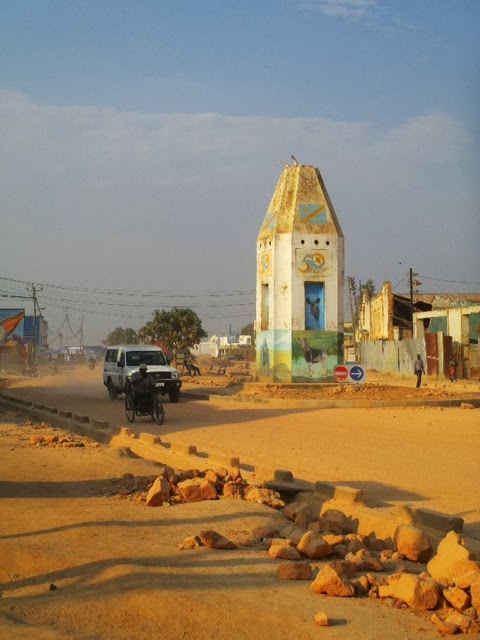
I know it’s mentioned it previously (multiple times. I’m very single-minded lately, but I suspect that you would be, too), but it’s the dry season here. And, in the era of climate change, this is serious business – even the locals are complaining. I’ve also kvetched ad nauseam about the dust (one of my colleagues recently called the massive plumes stirred by the wind ‘majestic’. I was terribly proud of myself for my restrain in not smacking her) but…it’s pervasive. Walking outside, the effect is immediate. I can feel the dust settle on my hair and coat my skin in a fine talc. My eyes begin to sting and my throat becomes parched. The grit gets in your teeth and textures your tongue. It is not remotely majestic. It is unforgiving. The dust doesn’t even whirl (again, respectfully disagreeing with my rose-tinted colleague here) – it billows in harsh, menacing waves. It dulls everything. This is a truly beautiful country, but the longer the dry season progresses, the more it’s bucolic loveliness is leached from the surroundings (I readily admit that this might be a question of perception – as the season marches staunchly on, I get more and more tetchy). The light in Bunia has become harsh and flat. It bleaches and drains and renders the world in sepia. Even the clouds are lifeless and two dimensional. The sunsets can occasionally be really striking, though. 

To my mind, and thereby illustrating how deeply frivolous and narcissistic I am, one of the most irritating consequences of the Great Bunia Dust Bowl is the curtaining of leisure activities. This is, hands-down, the worst my asthma has been in years. Practicing Pranayama, not to mention going running, has become a rather fraught endeavour. I’ve also been doing a lot of slack-lining lately (don’t ask. There’s a cute French man involved, and that’s about all you need to know). It’s surprisingly fun, and I’m (slowly. Ohhhh, so slowly) getting better, but I’m not sure if it’s a matter of actual improvement or simply and intense desire to not have to dismount from the line. Where once I would have had a mattress of verdant grass to cushion my falls, I am now met by the hard ground. Twigs and clumps of dead grass adhere to my feet and dust clings to my yoga pants (how unsightly! What will the cute French man think?!). It’s harder to walk the line with debris all over your toes.

The dust also has moments – generally transportation-related and independent of a generalised lowering of lung capacity – when it can be downright dangerous. Case in point (or two): a mototaxi passed me this morning with a toque pulled down to the level of his chin. I’m unconvinced that he could properly see where he was going, but I suppose it’s all a question of priorities. Similarly, last week, someone (who really should have known better) unthinkingly turned on the AC in our Land Cruiser, not wanting to open the windows to the dust. It was like a haboob in the car. Apparently some of this is Sahara sand, so it’s not an inapt comparison.

Bug prevalence is also worse, or at least so it seems to me. I’m not sure if it’s water related, but it seems that nearly every morning there is a new cockroach inverted on our kitchen floor. In their down-side-up panic, they try to fly, spinning, no whizzing around in circles like some grotesque wind-up toy. They can survive for days like that. I would rather have expected the mosquitos to lessen, but they’re magic. I have been interested to note that when you successfully slap a mosquito, the body squishes to one of your limbs while an outline of it is left imprinted into your slapping hand, almost distressing in its detail (my hand-eye coordination as really improved, buoyed by an intense desire to not get malaria again). What with all the infestations in the bath and bedroom, I feel like I check myself for creepy crawlies more often than a meth addict.

Maybe would be easier to look past the dust if there was any possibility of relief. But there isn’t. You see, what with the lack of rain, we have no water. Generally speaking, the house depends on rain run-off to fill several massive cisterns dotted around the property. We’re also hooked up to the city system, of course, but they ran out of water weeks before we did. All of Bunia is experiencing a shortage. Even the broad spot on the river that serves as the communal car wash has been shuttered for insufficient H2O. Our logistics team had to go out and forage a tankful from the river farther out and then truck it back in.

When it arrived it was…somewhat less that pristine. Really, it looked more like rooibos tea (if only it had smelled like it, too). It’s difficult to feel truly clean when you’re taking a bath in dirty water, but you do managed to feel refreshed, I guess, so that’s something. On the bright side, my hair has great body and texture right now and my skin is terribly well exfoliated. We’ve also had good fun joking that too much time in Congo turns you into a mud-bath taking hippo. Look out if I start becoming super aggressive and territorial.

The paucity of even dirty water has created something of a merry water war between the two houses on our conjoined compound (resource wars involving humanitarians seem like a wonder premise for a topically absurdist play, no?) that is aided and abetted by our rotating guard staff. We are periodically able to convince one guard to siphon water from the main house so that we might have a shower, only to have them steal it back for drinking filtration while you’re mid-shampoo rinse. Despite the obviousness of these shenangins, no one talks about it. It’s Water Fight Club. Occasionally, I furtively wash up at the main house (a pre-yoga foot scrub behind enemy lines!) and enjoy the most absurd sort of gloating accomplishment for sneaking one past my teammates turned advisories.

What I really don’t like to think about with regard to the quality of water we’re working with right now is that this is the same water in which we wash cloathes (assuming that we even can. We’ve actually put a temporary moratorium on laundry, which is becoming increasingly worrisome as my stock of unmentionables dwindles down to nothing. I’m going on R&R soon people! A girl needs skivvies!) and – worse, to my mind – dishes (it’s fine for drinking, incidentally. Our water filtration systems are aces, which one would expect from an NGO that specialises in WASH). Someone chided me for not washing off a piece of fruit before cutting it for a salad, reminding me that this is Congo! Sure, I thought, which means that there are no pesticides on this fruit, and it’s not like the dirty water will make it clean from the dust of transport… Someone else made the rather tragic mistake of looking in our water tanks. The spit of liquid that remained was apparently covered in an oil-slick film. All in all, I think it’s an amazing accomplishment that we’re not half-dead all the time. Here’s to the resiliency of the human body!

If I look past my personal inconveniences, the dry season is not all bad. Cholera epidemics, for example, rarely occur during the dry season and it’s a great time to vaccinate kids (measles and meningitis are worse, though. Malaria stays the course. It’s tremendously consistent, as far as murderous epidemic diseases go – I blame those damn resilient mosquitoes). Travel is also much, much easier. Partly because of that, the cost of many goods, including food and medicine, noticeably drops.

Finally, it’s a great time of year for major construction projects. On this bright note, and in no small part due to the recent visits of both the President and (muzungu!) Governor, work on the main road has progressed steadily (steadily, but not quickly. This is the central boulevard through all of Bunia, and it has been closed for going on three weeks now. Getting into work has been…complicated, greatly increasing the traffic volume on the narrow market road we take and adding burning tar to the dusty bouquet of Bunia scents). Once they completed tarmacking the first stretch of road, we were treated to the rather endearing site of people strolling along the finished product, dressed smartly, a great many of them be-hatted. I found it terribly Victorian of them.


I’ll end with a final happy piece of news – based on the trees in our yard, mango and avocado season are just around the corner, and there are dark clouds massing on the horizon. Things are really looking up!