30 August 2013

Muzungu in the Mist

My R&R in Uganda has come and gone and it was, in a word, amazing! Perhaps not surprisingly, Uganda was in many ways quite similar to Congo but infinitely more relaxing, if not for the reasons you might expect (lack of work and armed conflict spring to mind, though that was certainly a welcome change). Perhaps the most striking differences for me were how much more obviously wealthy it is (this is all in context. With ‘wealth’ I am referring to the abundance of cattle, full service gas stations, and tarmacked roads), and the use of English as the lingua franca. Though I was surprised at how difficult it was for me to kick the habit of greeting everyone with ça va. 

I only spent one night in Entebbe before setting out on safari. Entebbe is a lovely little town on the shores of Lake Victoria and is about 45km outside of Kampala. I stayed that the guesthouse preferred by my colleagues (after the troubles in Bunia last November, they were evacuated and stayed there for more than a week) and ate dinner at a local pizza/Indian fusion joint on the shores of the lake. Though it was not more than a 10 minute walk, I ran into the owner of the guesthouse on the way back. She was so concerned about me walking alone in the dark that she actually drove out to fetch me, making an educated guess on my destination based on where everyone else in my team eats. We are communally creatures of habit. When I protested that it really wasn’t necessary, she observed that getting roughed or having my back taken would not put me at full strength for my trip. True words, Madame.

At promptly six am the following morning, I left for Kampala to meet my tour guide (for a vacation, there were an awful lot of early mornings). Gordon seemed pleasant enough, though our lime-green Mystery Machine managed to break down before we were even out of the city.
As I was waiting for Gordon and the two mechanics he enlisted to fix the fuel pump somethingorother, I passed the time by listening to PSAs for prostate exams as told by the tragic tale of the near-do-well John and his long-suffering wife. The ad concluded with John’s imminent death, the announcer gravely intoning that 50 per cent of people (people, not men, I was amused to hear) who get tested late for prostate cancer die. Statistically speaking, 100 per cent of them die, but I shouldn’t quibble. There were also good ones for mosquito nets and fighting disease in banana plantations. Welcome to Uganda!

It was a long drive to Bwindi Impenetrable Forest, in the south west corner of the country (apparently, I should have just grabbed a boat from Goma), giving Gordon and I a chance to get to know one another. When I explained that I’m living in Congo, it seemed to invite him (and indeed, any Ugandan to whom I was speaking) to heap vitriol on his neighbors. The Congolais can’t cook, but apparently will eat everything including snakes, doges, and in some cases, people. They are beggars and dirty and lazy. The army is composed entirely of cowards. That they have such a rich country and are so poor just highlights their incompetence or stupidity or idleness or all three. Only one young guide I spoke with had anything positive to say, noting that Congolais are on the cutting edge of the music scene and make great dancers.

When they weren’t scornful, they often expressed a rather shocking naiveté. Congo? Is there still a war there? Well, that depends on how you define it, but lets’ go with yes. I haven’t seen the UN helicopters in a while. They are still there, too? Sweet fancy pants, yes. It’s the largest mission in UN history, and it just got bigger! Even people back home know about the Intervention Brigade! And how is the war going? I honestly have no idea how to answer that, but I’ll go with sucks for pretty much everyone (on a related note, two UPDF battalions accompanied by battle tanks actually entered Congo the last weekend I was in Uganda, and folks were still asking if there was a war going on. People. Your army just invaded! I think this level of apathy would give most Americans a run for their money).

Likewise, sharing my profession yielded all kinds of advice and suggestions and project ideas. Gordon himself inquired why I don’t suggest to Obama to step aside and allow the AU intervene to fix Congo. I…there are so many amazing assumptions inherent in that question that I didn’t know where to begin. Obama is also, apparently, the rudest US president ever, on account of his failure to his is distaste for Uganda’s President Yoweri Museveni, in addition to being a huge hypocrite for killing Qaddafi. When I protested that President Obama did not, in fact, kill him, Gordon amended the comment to allowing Qaddafi to be killed, but suck to his guns (this defense of Qaddafi struck me as trés bizarre. Sure, Qaddafi and Museveni have been frenemies for a while, but the man supported the LRA for years. Then again, at one point Gordon dismissed the north as just full of poor people, so perhaps he could care less about the horrifying things the LRA did).
There was money in the banana stand (it's the main cash crop in the area)
At some point, our discussion turned toward domestic politics. Gordon fervently hopes that Museveni will continue his 27-year-long presidency for the next 5-8 years. Although he admitted that, sure, Museveni’s government was perhaps corrupt (he justified this with the Uganda proverb ‘a man eats where he works’), and yeah, some people he may be hard on (like the opposition, civil libertarians, and the entirety of the queer community, and really any gathering of more than three people, but I suppose you can’t please everyone), but he has brought the country so far! Gordon expressed a rather profound fear of civil war, opining that only Museveni was powerful enough to prevent it. But he was concerned that Museveni seems to be positioning his son to take power upon his retirement/death, and that didn’t strike him as the right course.

This was also when I began to keep a running tab of the number of times someone needed to confirm that I was traveling alone or had no boyfriend. By the end of the trip, it had happened least two dozen times. In the interests of full disclosure, I counted in this tally the times someone told me that I needed a man and the many occasions Gordon propositioned me, including: explaining how, if we were to end up together, he would make me eat meat (one of the many reasons we never will, I responded); whenever he referred to us as lovers or suggested I sleep in his bed; the time he offered to sell me to someone for 37 cows (the man demurred – here, we use goats, he explained); and the numerous instances he flat-out asked me to marry him. I did not include the references to how common it is for whites to marry Ugandans or how he was looking for someone, and, say, wasn’t I? I have to admit to being a bit flattered by the 37 cows quote. On the first day of our trip, when Gordan was flirting with a waitress, he suggested that she send his mother two cows, and then she could have him. That I was worth so many more was very complimentary.

Sporadically throughout the trip, Gordon also gave me Swahili lessons. Msichana – girl. Mvulana – boy. Wewe ni mzuri – you are very beautiful. I’m wasn’t sure how much use these will ever be, but decided just to go with it.

Not a moment too soon, we arrived at the Bwindi Impenetrable Forest (a UNESCO World Heritage site!), home of the mountain gorilla. The name is an entry for the redundancy department – Bwindi means impenetrable.
The line between farmland and national forest is so clearly drawn it's hilarious
And the eve of my trekking expedition, lest it seem like all I’ve done was gripe about my driver, Uganda already rocked my socks. The ‘camp’ at which I was staying welcomed me with a roaring fire, fresh juice, and tea with warm milk, while the tent had indoor plumbing and a glorious view. And these were the budget accommodations! As I took a shower ‘under the sky’ in a rainstorm, I have to admit that, in that moment, I thought I could stay in Africa long-term. I fell asleep with a hot water bottle against my toes and rain lulling me to sleep overhead.

I woke before dawn to prepare for my gorilla trek. The camp manager handed me a bag lunch on my way to the pre-trek briefing (a juice box and sandwich. I felt like I was seven). I was assigned to the Kyaguliro Group, which is currently being observed for research purposes, and given a litany of instructions. Don’t go closer the seven meters to the gorillas, though they are likely to wander closer than that to you. When do, stay still and be calm. If they get aggressive, do not panic and do not run. Adopt a submissive attitude and back away slowly. Do not mimic the sounds of the gorillas. If you take video, do not play it back in their presence. Do not make eye contact. Do not use a flash. Do not cough around the gorillas. Got it? Got it. And then I was off with park ranger Israel and German tourists Ursula and Constantine (as well as two armed ‘escorts’ who were apparently there to scare off forest elephants.We were hiking for not too much more than an hour when we met up with the tracking party. We climbed a bit further and heard some low noises of grunting and shaking branches, and suddenly found ourselves in the midst of gorillas!
I cannot begin to capture the amazing feeling of watching a blackback make coy eyes and play the diva as he pulls a vine off a tree or seeing three babies tumble with one another among a tangle of roots or just standing still and listening to them converse. It was surreal. So, in lieu of trying more than I have, I’ll just offer lots of photos and some statistics. The family had two silverbacks, four blackbacks (as the adolescent males are known), seven females, and seven babies. The youngest wasn’t more than a few months and the family was very, very protective of it.


I enjoyed the most profound sense of serenity and joy for very nearly an hour (you only ever get an hour with the gorillas) when the rangers decided we needed a better view of the alpha silverback. We got to within the prescribed seven meters (and a bit closer, honestly) on a steep slope dense with undergrowth. We were more walking on a net of leaves than the ground itself, and our footing was both treacherous and pleasantly bouncy. That was about the time the silverback got…aggressive. There wasn’t any beating of the chest, but he started growling and then screaming, then bared his teeth, and finally charged us. I have to admit, had my traction been better, I would have beat cheeks (like that would have gone well, considering that even the recommended backing away was nigh impossible and gorillas are surprisingly speedy). As it was, I slipped a bit, causing the rangers to hiss to stay still. By the second charge, I had decided that, were I to die, death by angry gorilla was not such a bad way to go. Imagine the headstone possibilities!
We eventually realized that he was posturing to protect the baby, who was carried past us by his mother during the second charge. That was amazing on another level – being sandwiched between this adorable infant and furious papa. If gorilla trekking was not already on the to-do list for your life, please add them now.

On our way to Queen Elizabeth National Park the following day, we made a not-so-quick stop so that Gordon could pick up some shoes. In the process, he stumbled upon a park guide who needed a lift. In fact, almost the whole trip we acted as a taxi service for stranded guides and hotel employees. Not that I minded. It meant he spent less time talking about our pending marriage. And, often, the guides directed us to the best spots for animal viewing. This first time, the ranger in question worked in an area where lions are known to climb trees. Though we didn’t manage to find any, I so much wanted to see some that every rock or termite mound became a mane, every hanging vine or branch a lazy tail. We did make a stop at a tea estate, which was pretty spiffy.

When we finally arrived at the park, I was almost immediately loaded on a river cruise. It sounds more posh than it was. I was joined by a surprising number of birders. They were almost as much fun to watch as the birds themselves, one stalking the other stalking water bugs through the shallows. They (the people, not the birds) were outfitted with mammoth binoculars, but used camera photos. One actually held the phone up to the binos. I would love to know how that photo came out. Ultimately, I managed to turn my attention to the mammals I was supposed to be watching.

I was interested to discover that I have a here-to-unknown love of hippos. I could have watched them for hours, enjoying how they emerge from the water coquettishly, bashfully, only to start and snort water high in the air, as if mortified you caught them. Water buffalos, meanwhile, always seem to look either forlorn or disgruntled. There were village kids swimming in waters that housed not only the highest concentration of hippos in the world, but also Nile crocodiles and a variety of water snakes (the park was established well after the village, and now proceeds go to support their health, hygiene, and education). The guide on the boat observed the children and then felt the need to remind us silly tourists of us how extremely illegal this was.

Despite having told me the night before that we would leave at 7h00, Gordon arrived for me at 6h30. It was a good thing that I was already up and meditating (on him, nonetheless. That…isn’t as creepy as it sounds. I was going for patience and serenity). Also, he was deeply hung over. Happily for my olfaction, we were rolling with windows down. He explained that he had met up with several of his fellow guides for a beer, and might have had a few more than planned. He further apologized, not for being so slaboo, but for not inviting me along. Given that a) they almost certainly wouldn’t have been speaking English, b) his innuendos probably would have crossed a line, and c) his preferred drink is cold Guinness and Coke, I was unspeakably relieved that he didn’t. Although his driving improved as he dried out, it was still a bit erratic as we careened around a corner and into the middle of a herd of elephants. We skidded to a halt, startling some babies back into the foliage. An older elephant flapped her ears at us in gentle rebuke for our dramatic entrance. Watching them move gracefully, somehow noiselessly, in the predawn light washed away any lingering irritation I might have had with Gordon and return me, if only briefly, to the meditative state I had abandoned. It was too dark yet for flashless photos, and I didn’t want to scandalize them like that (having to flash them…get it? Sigh).

It was in much better spirits, then, that we set off for the remainder of the game drive. The sun was breaking through the cloudy memory of the early morning rain, kissing the green waves of the grasslands with fire. I saw all manner of assorted herbivores and birds – topis and impala and buffalo bathing in the salt lake, munching, playing, nursing. At one point, we heard the rumor of a lion and some 15 tourist vans and Land Cruisers and Range Rovers in various states of disrepair jetted to the same spot, only to be told it had vanished into a thicket. Gordon opined that someone had played a joke. It certainly had a sense of theatre of the absurd, watching all of those ungainly vehicles try to navigate around each other in the mud and muck, camera-laden tourists hanging out the top and swaying like dashboard hula dancers. But I loved watching the topi frolic and the water buck pace with stately grace. Though I had given up on lions I consoled myself that the entire point of this journey was really gorillas – everything else was icing on the cake. I had a few more elephant sightings and even some of my beloved warthogs (warthogs, for those who don’t know, are hilariously in person. In my mind, they are the absurdly pompous dandies of the animal world and I love them for that).
Then, just at about when we had decided we were hungry and it was high time to head back, what was that in the grass? A languidly undulating tail? Some black-tipped ears, perhaps? We stopped smartly, but she had disappeared. The guide in the car behind us – the only other one around, as the gaggle from earlier had broken up – didn’t believe that we had seen anything, but his passengers encouraged him to take a closer look so he pulled his Land Cruiser off the main track. Gordon wasn’t sure that our battered Mystery Machine would be equal to the task (it had been falling apart in bits and pieces throughout the drive, malfunctioning just about every time we left tarmac roads. The previous day, a particularly vicious bump had caused the cover to the glove compartment to completely disconnect and an empty Nile Special bottle to drop on my toes. Gordon claimed that the roadie wasn’t his, but I have my doubts), but these were my lions! I urged him to give it a go. And that is how we ended our morning with the magical charm of watching a mother snuggling with her eight-month-old cub (eight months was Gordon’s estimate, and while on the subject of doubting Gordon is still fresh in our minds, I at times wondered about the thoroughness of his guide training. Remind me to tell you about the plant he claimed was 100x more addictive than cocaine, or the herb that would magically make me crave meat – especially liver – and that he threatened to slip in my omelet one morning. Credit where credit is due, though, the man knew his birds. I think he was disappointed that I wasn’t more of a birder. It seemed to be a German thing).

I have found that I tend to value most that which is unexpected (like the unsung charms of Goma). I anticipated the majesty and grace of the elephants and lions. Which isn’t to say that I didn’t adore them, but the highlight of the day might well have been the unaccountably cool tour of the salt lake. Where they actually farm salt. The ground in this area is apparently super acidic and most of the bodies of water are naturally salt producing (among all kinds of other, more noxious things. One of the lakes is called ‘smelly’ in the local language, though they all smell like sulphur). The non-farmed ones make for great animal viewing – they go by the herd to add minerals in their diet and clean wounds. Meanwhile, the lakes also produce by the bucket load algae that is favoured among migratory flamingos. Some of the larger lakes, however, have been cultivated by the locals in some way or another since the 1400s. They build salt ‘pans’ along the lake shore by lining pits with grasses and wood and then fill them with water from the lake. They can only be farmed during the dry season, when sustained evaporation cases a thin layer of salt to form on top of the pan like ice. The farmer keeps building layers of salt crystal until it hardens and sinks, at which point they harvest and purify it (by stomping on it like wine grapes!) until fit for human consumption.
In the lake itself, the farmers dive down to the lake bed where salt rock has formed. This is gathered for industrial use. Where the plots . are individually owned like plots of land and are passed through families for generations, the lake divers are more or less unionized. Because of the astoundingly high salt content of the water, women are only allowed to work in the pans – the continual emersion of the rock harvesting causes too much damage to their fallopian tubes, apparently. As it is, they already have a worryingly high prevalence of miscarriages and the male divers have to wear condoms to protect their foreskins. They also suffer from near-constant dehydration and have to find alternate employment during the six months of the rainy season, when salt can’t be harvested. Somehow, though, the lake employs some 5000 people and they are actively fighting to preserve their way of life in the face of efforts by a large company to buy up all the pans and rehabilitate and old factory built by the Germans in the 1950s. It was like a super warped version of Erin Brockovich. My charming guide, Michael, pointed out to me that the like was shaped like bean of kidney, or a hornless Africa. Uganda exports its salt throughout the region and, for reasons unknown to Michael, China. 
You can see the rafts of rock salt being towed through the lake
By the time Gordon came to fetch me, the MM was no longer able to reverse. Only three days left to go!

24 August 2013

Don't judge a town by the threats to overrun it

Once we were wheels up, it took less time to make it back to Goma than it did to drive to the airport. In a first, I took some flack from the DGM with regard to my visa. The officer claimed that it was invalid because it lacked an expiration date. I have to admit that he is, strictly speaking, accurate. My visa has no end date. However, it also clearly states that it is good for three years after the date of issue, and that is written on there about seven times. When I pointed this out, he harrumphed and consulted and harrumphed some more and then let me through. Which is pretty much all they ever do (on a side note, even if it was invalid, what exactly does he expect me to do? The things are issued in Kinshasa by his own department). It’s not just the passport – travel within the DRC is an exercise in bureaucratic inanities and red tape. One must, at all times, have readily available your yellow fever card, Go Pass (this is a bit like an exit visa, but for cities. You have to cough up 10 USD every time you take a domestic flight and 50 USD for an international one), ordre de mission, the whole nine yards. If you fail to have all I’s dotted and T’s crossed (preferably double-crossed and validated through two different offices), you open yourself for brides. As if demanding that every NGO worker have to register – and pay associated fee – every time they operate in a new territory isn’t bribe enough! Yes. You pay when you enter and again when you leave. My recent trips have cost more than 100 USD in these DGM fees alone.

But I really shouldn’t kvetch – my supervisor and frequent traveling companion has it even worse. She recently ordered a new passport, as the old one had run out of pages. Again, though, our visas have to be processed in Kinshasa and it might well take as many as three months for them to transfer the active visa to the new passport. Therefore, she is now traveling with both the old and new passports, and the DGM has a conniption every time. Most of the officers claim that she is traveling on two travel documents, one of which is expired. One even threatened to hold her in the airport. Technically, neither passport is expired, but one sly DGM suggested that she just tape the old and new passports together. That way, they are to be counted as a single document, and you can apply the visa in the former to the expiration date in the latter. Even more absurd that the suggestion itself? The fact that it seems to work! Or at least mitigate their suspicion and tendency to overreact.

Given how much we’ve been bopping around, we were ready with sheaf of documents in-hand when we approached the immigration desk. When they utterly ignored our yellow fever card, we were a bit taken aback and asked if we didn’t have to present them for inspection. The DGM (the selfsame one who wasn’t happy with my visa) looked over at the sanitation desk to his left, manned only by a cockroach, and shrugged. ‘Ils ne sont pas ici’. I guess not then. It’s all such a farce – nothing more than a puppet show intended to preserve the semblance of governmental control in a country where even the most basic social services are provided by the international community. 

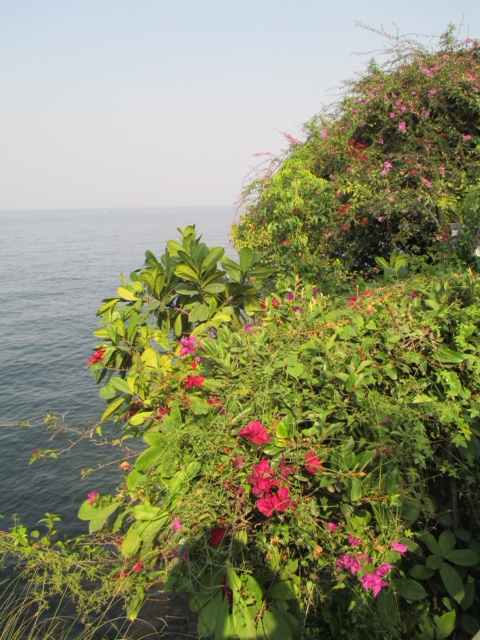
This will be apostasy for most familiar with Congo, but I think I prefer Goma to Bukavu. It lacks the latter’s terraced elegance, certainly, but it still appeals to me more. I’ve tried to explain why to myself, but I can’t quite seem to put my finger on it. Perhaps it is because it wasn’t so built up in my mind, with everyone insisting that it’s paradise (Bukavu was a bit like Tir Asleen, to be honest). However, I suspect it also has something to do with the lava - the enormous chunks of lava piled up like the toys of a careless, giant child. It somehow makes the city seem younger, more raw. Where the red Bunia/Bukavu dirt coats everything, leeching colour out of it, the black Goma dirt makes them pop all the more. The green of the abundant foliage and red and purples and yellows of the flowers all take on a new vibrancy in Goma. Even the trash looks richer! That said, it is awfully hazy – the water and sky run together so the horizon vanishes into a stretch of grey-blue that is both flat and endlessly deep. I could barely make out the volcano.

There are certainly other, more tangible reasons why this city appeals to me. For one, the statuary is more interesting. In Bukavu, the heart of the city is dominated by an enormous, unruly roundabout that orbits a similarly massive stature of well-muscled half-naked men proudly holding symbols of liberation, most prominently a torch and an AK. Meanwhile, the circle nearest our Goma hotel sports animals including a gorilla reclining on a rock chaise and an elephant splayed out like it just lost its footing on the proverbial banana peel. My favourite by far is the ode to the Chukuda (in my head, I keep hearing this as chupacabra, which causes me to giggle at totally odd moments). It’s a blend of skateboard and wheelbarrow that is wholly unique to Goma. In the statue, a golden young man (again, super fit and shirtless) pushes one that is laden with the world. Deep, masons of Goma! 

One always hears how dangerous this city is (in fact, I seem to remember promising my mother that I wouldn’t go to Goma. Sorry, Mom!), but we walked around as freely as we did in Bukavu and much more so than we do in Bunia. The biggest risk we faced was a tie between spraining an ankle on the terrible…sidewalk in not the word. Maybe strip of lava too rocky and broken to drive on? and the motorbikes when the non-sidewalks vanish, to the extent that they ever existed, and you walk directly on the road. While there were certainly more beggars in Goma, there were also fewer people asking us muzungus specifically for handouts. There were, however, also more cat calls, as well as men making kissy noises and a strange sssst sound. And children just seem inclined to follow you about. A group of kids playing a game of hoop stick trailed us for a good 20 minutes. Finally, my boss snapped at them in Dutch and they scattered. 
The sense of security might have had to so with the fact that there were soldiers and UN peacekeepers everywhere you turned. Granted, this wasn’t always the most comforting sight, especially given the tendency of the FARDC to wear belts of bullets casually looped around their necks like scarves.

Indeed, remember me waiting for some gunplay to break out? It was because, as we left our hotel early Sunday morning to attend Mass at Notre Dame du Lac (Cistercian nuns!), we were sidelined by a fleet of probably around 30 motobikes, each with 2-3 cops on the back, the butts of their rifles and assault weapons resting on their thighs. We considered for a few minutes whether it was worth it to soldier on as we waited for the dust to settle. We had decided God would applaud discretion over piety this once by the time the last motorbike passes us, it’s bemused brace of passengers putting me in mind of a certain Blake Edward’s zebra. I wondered if their commander would have their stripes for this.

Apparently it was just a lot of sound and fury. Some people had started stoning a UN convoy and, though it never amounted to anything beyond that, they’re on high alert and prepared for riots such that even small incidences result in heavy deployments, road closures, and evacuation of UN VIPs by helicopter (all of which happened while I was sitting by the lake and smelling the flowers. I felt wildly disconnected from the truth of Goma). 
Ultimately, though, we did find ourselves once again at the airport (where we had to pay 50 cents for the privilege of using a bathroom that lacked both toilet seats and paper. The last time someone tried to make me pay for the bathroom, I was a Harold’s of London). And, frankly, it was about time. My cloathes were all well-past the point of needing a wash and I was eager to see my friends and colleagues in Bunia. Most of all, though, I was looking forward to an absence of meetings and getting back to my ‘real’ job. In order to shave a few days off the trip, we had briefly entertained the notion of taking a local airline, CAA, as the humanitarian airline doesn’t fly all that often. Do you also recall the crashed planes that still line the Goma runway? Nearly all belonged to CAA. When we shared our fledgling plan with one of my other colleagues, it was met with a horrified ‘but you’re too young to die!’ I don’t know about that, but I am too financially savvy to risk my life for 400 USD for a 30 minute flight when it’s cheaper to hang out at the hotel for two more days and take the humanitarian airline that actually does maintenance on its planes. 
I’m leaving out loads – like the inter-NGO sniping, the woman who is trying to rehabilitate child soldiers through praise dance (life skills and vocation trainings are so passé), our lingering suspicion that our hotel was in fact a super classy brothel, and how I somehow ended up acting out the inter-testamental period with cardboard swords, table cloths, Mardi Gras beads …but I’ve got to get ready for my safari, and I really am trying to shoot for brevity. Next time – gorillas!

16 August 2013

I took the one less traveled by

Despite my best efforts, I’m still not fully convinced that Mr. Frost had it right. The road that wants wear might not have been the best choice. I’m prepping for my first R&R (I kinda wish it weren’t so quick on the heels of the last two work trips, but at least the time has been passing quickly). Those of us in Bunia get a five day R&R for every 12 weeks in-country. Some whine that it’s not as much as the field bases, but it is so much nicer than Afghanistan! Sort of. It was surprisingly difficult to find someone to come hang out on the Kenyan coast for two weeks. Instead, I’m going to Uganda for the five day minimum.

As excited as I am to see some gorillas, booking a safari for one is a bit of a downer. I’ve had two companies come back and ask for confirmation that I’ll be traveling alone. As if I wouldn’t know. It’s like trying to go out to eat by yourself at a restaurant. You can sense the same pity in the email that you see in the server’s face. Oh, you poor woman. You think you’re so empowered. If you don’t learn to be less demanding, your eggs will expire.

Apparently, my neuroses have turned everyone in the service industry into my intrusive and judgmental grandmother.

Vacationing alone is not exactly an uncommon occurrence among people in my line, though. I was discussing it recently with the others (women) in my team, reflecting on how hard it can be to travel alone. We concluded that to do so effectively, you really have to know yourself. Are you happy to sit on a beach and read? Go to Zanzibar. Crave a nightlife so that you might meet new people? Try Kampala or Nairobi. Really just need a good cup of coffee and some cheese, price be damned? Amsterdam is calling. I would feel lonely and enter a spiral of self-loathing on a beach and be full of trepidation in a city I don’t know, so it’s gorillas and mountains for me!

For a lot of humanitarian workers – or soldiers, or contractors, or really anyone who lives abroad – this life can prove emotionally isolating. You talk with your friends and family about their lives, because it’s easier for you to relate to them than vice versa. It’s not that they don’t want to. It’s just that it is so different and can be hard to absorb. Moreover you don’t always want to share – it gets to be like an unintentional game of one-up-manship. You were fighting with Pepco about your bill? That sucks. We haven’t had power for a month. You forgot to get a shot at CVS and now you think you have the flu? I totally understand – this is the third time I’ve had malaria. Your new apartment is a little too close to the bars and it can be hard to sleep because of the noise? Totally – the rats and bats that live in the roof keep me up at night, too, when they start running around. Oh, you had a hard day at the office? We had to evacuate to the UN through the secret door in the back of the compound because the rioters were burning cars at the front gate (though all true, these are not exclusively my personal stories; I’ve gleaned several from colleagues). And for what it’s worth, we do it to each other, too. Oh, your significant other broke up with you? How sad. I just found out my dad died and now I have to figure out how to Skype in to deliver the eulogy.

Some people live for this difference. They toss out antidotes about bribing their way across borders or being menaced by child soldiers and then say TIA with a jaded laugh. I think that each of us strive for that somewhat. I mean, that’s pretty much what I do every time I write on here. So, yes, I do recognize the hypocrisy of complaining about how I have no one to listen on a blog. Seriously, though, ten people read this and four of them are either in Pakistan (which makes sense) or Ukraine (which…does not). To the Pakistanis, I’m sorry it’s no longer about Afghanistan.

But as much as we all reach for the studied air of the blasé aid worker, we (I) eventually get sick of putting on that armour. You get tired of making jokes about things that actually horrify you, and are too scared to admit to being horrified in the first place. So you just stop talking. How are you? I’d love to say ‘well, I went to sleep to a rat behind the tomato bowl and woke up to a cockroach in the sink. How do you think?’ But I don’t. just say ‘fine, thanks. How’d you sleep?’ So much easier just to say that you’re super busy, but the work is really rewarding and the experience is amazing and you’ll send more photos soon. At most, people want something uplifting about the work – to feel like there is some good reason why you’re so far away – balanced by funny anecdotes about how bad the roads are or the lizards you have to chase out of your bed on the cold nights. You don’t talk about the crushing loneliness or the doubts or how empty you feel or how, at some point, even the lack of power and constant cold showers move from adventure to annoyance to exhausting, monotonous reality. How you wonder if the deprivation is worse because you know that you don’t have to live like this, and then how you second-guess your choices, and then curse yourself for being both weak and spoiled. You don’t talk about it with other NGO workers, either, really, because you desperately don’t want them to know how weak you are, either. So you sit, in the quiet moments alone, with your fear and self-loathing and pain, and wait for the next morning when you can bury it all again.

You hope that there is at least one person who will be your anchor (we actually call them that. Not anchor. Person. Who’s your person, we might ask of a colleague in distress. Have you talked to your person?). Who will be willing to understand life the way you understand theirs. To ask about your day beyond ‘how’s Africa?’. And if you don’t? Well. Better words of wisdom come from Dag Hammarskjöld. Pray that your loneliness may spur you into finding something to live for, great enough to die for.

'The Switzerland of Africa' might be false advertising

As I write this (write, not post. I suspect I’ll be in Bunia by then (I was right!)), I am looking out over Lac Kivu on a beautiful, sunny Sunday, sipping water with lime and listening for gunshots. There will be more on that later. Let’s start with how I got here and what I’ve been up to for the last week or so!

As our donors are convinced that Province Orientale is transitioning to a ‘development’ phase (never mind the hundreds of thousands of displaced people or rampant sexual violence or lack of potable water and latrines or cholera epidemics or…well, I guess I’ll stop there), they have begun to pull their funding. Accordingly, headquarters has turned its attention to the donor-friendly morass to the south, and it’s my job to sniff out likely projects associated funds. So it was that, a week ago last Tuesday, I was chilling in the Bunia airport with my boss, having spent nearly four hours waiting for a flight that had been delayed and then re-routed, being moderately entertained by a variety show. As I watched, the show segued from impersonators of Kabila and Mobutu to selections from the Occasional Oratorio, Carmen, and Messiah. Who knew the Congolese were such Händel fans? We had moved on to music videos for Congolese pop standards (which were even stranger, if that’s possible. The featured dancers writhing around in business casual interspersed with the Passion as played by a bunch of appropriately Middle Eastern-looking folks and a verrrry European Jesus) by the time the rain started and then a PSA for the World Bank when the flight was confirmed as cancelled.

When we finally did depart for Goma – a mere two days later – I was eager to see this city that is so much in the news for all the wrong reasons. The approach took us in over the lake and from that vantage the beautiful water-front hotels and manses quickly give way to tin-roofed slums.

The Goma airport is the nicest – most ‘real’ – I’ve yet seen. One can almost imagine that it’s in a mid-sized American city, at least until you hit immigration (yes, we had to pass through customs after a domestic flight). Only two people were working the immigration and health and sanitation desks (admittedly, it was a national holiday. Happy belated Parents’ Day!) and I’m fairly certain we woke one from a nap. The other not only offered to find us a taxi, but ended up driving us to our hotel himself. Still in uniform, nonetheless (turns out he overcharged. I suppose I shouldn’t be surprised).

I will cover Goma in greater detail later. Right now, sufficed it to say that it is just like Bunia, but bigger, dirtier, and with black soil instead of red. Our hotel, though, was amazing. The grounds were beautiful and included both a pool and a sauna. Over dinner, we began hatching all manner of plans on how we could go to the gym and get a massage before our flight, only to find out that our ETA for the following morning was 0600. Oh, what might have been. Happily, I did have time to utilize the bath tub (!) and deliciously hot water (I soaked for close to an hour and watched some Buffy. It felt almost sinful).

The early morning departure highlighted the dichotomies that have come to define both Goma and Bukavu in my mind. As we ate breakfast, we watched the sun rise over the lake, mist rising off the water and the warm tangerine of the sky gently distorted by the waves. I could almost feel the denizens of the garden stretching their petaled faces toward the first light of day. Then we left the hotel. The morning mist blurred together with the exhaust and black dust and smoke from burning trash and filtered the weak sunlight so that the very air looked like it was burning. The few people on the road moved through the haze like wraiths. I had passed from paradise to purgatory in seconds.

In a bit of a reversal from most airports, Goma had their security/bag check prior to ticketing (the personal scan conducted on the runway - by the pilots, no less – with a hand-held metal detector just before boarding. We ALL set it off, and no one seemed to care). I was faintly impressed that they bothered at all. There was of course no x-ray machines; just a man pawing through my bag. I wondered about the efficacy of his inspection, as he averted his eyes throughout the process, I presume so that he wasn’t scandalized by the sight of some racy unmentionables. He did manage to come into contact with my sandals, which are studded, and my perfume bottle, which is crystalline. It took me a while to convince him that he would have to pull them out and look at them to be sure they weren’t, in fact, dangerous (he sprayed the perfume, because apparently sweet smelling things cannot be used as a weapon). Nothing was said about my 12 oz bottle of contact solution. While I was waiting for him to finish, a man in a long coat sidled up to me. I watched him warily out of the corner of my eye, sure he was going to try and sell me a genuine Folex watch or possibly flash me. It turns out that he was just the seediest cheese monger ever (Goma is renown in Eastern Congo for its cheese. It’s the only kind we can get in Bunia). I didn’t take him up on his offer.

More so than its counterpart in Bunia, the Goma PAX terminal (I’m using this jargon generously. There are no terminals here) makes for great people watching. At that hour most everyone was associated with some flavor of police force. Between the DGM, national police, Goma police, and various and sundry UN police and peacekeepers, they easily outnumbered the passengers 2:1. They all looked very impressive from a distance, in their smart uniforms and combat boots. Up close, though, their uniforms were patched and inconsistent. Often as not, their epaulettes were taped on a like a 5th grade craft project. The only thing that was totally consistent was their precisely angled berets. As I was having my passport processed yet again, the DGM misread my Ordre de Mission (basically, the paper that gives me permission to travel in-country) and tried to convince me that I worked for the BBC, nationality be damned!

After waiting a mere 2.5 hours for a 20 minute flight, we arrived at the Kavumu airport, about 40km outside of Bukavu. The airstrip is surrounded by the decomposing bodies of Russian propeller planes. The skin of the planes hangs from the metal skeletons in long strips. Cyrillic lettering and faded pin-up girls are still visible along some of the fuselages (I found these wreaks somewhat more comforting than the defunct planes at Goma, which are mostly recent acquisitions and are in far worse shape). After managing to identify the sole taxi waiting outside the gates, we set out for Bukavu, buzzing past the border with North Kivu as well as President Kabila’s vacation home. I only had time to form the most basic impressions – it’s dirty, crowded, with horrible traffic, lots of hills, and a slightly worrying prevalence of ‘fire ministries’ – before we vanished off the tarmac road and into a silent haven of lac-front hotels and NGO compounds.

The hotel claimed not to have our reservation, but it was no matter. We were shown to beautiful rooms, complete with a balcony view of Lac Kivu. I had mostly unpacked by the time they discovered that we DID have a reservation, and our budget had only allowed for third-class rooms. The view vanished along with the balcony and armoire. By Congo standards, I still counted it as a win. There was just enough floor space to unroll my yoga mat, the internet was good, and if I let the water run long enough, it turned from umber to clear, even if it never really got warm.

That first afternoon, we inadvertently photo-bombed one of those odd music videos I mentioned earlier as we ate a late lunch. The cast and crew kept coming over during breaks between takes to take photos while shaking our hands. They never even bothered to ask who we were. Indeed, despite there being a metric ton of muzungus in Bukavu, the sense of being noticed simply for my skin colour was unmistakable. ‘Muzungu manger’ (white person give me something to eat) was the chant used to set the marching cadence of the children who followed us around rubbing their bellies. The adults didn’t even bother to say anything – they would just hold out their hands to us. One woman had the temerity to do so from the passenger side window of a land cruiser.

Even so, we ended up walking for hours through this bustling city. And while it was a welcome change from Bunia, where we never walk, I’m not sold on why people love it so much. Certainly, the lake is beautiful, and the tiered effect is quite lovely, but when you back off of that and turn around, it’s pretty much just a city. Imagine San Francisco about 10 years after the apocalypse. There’s still a tremendous amount of the beauty that made this a resort town during the Belgian years, but little to nothing has been done to halt its decay in the last half century. As you walk along, you catch glimpses of the lake between the buildings and where you would expect to find terraced gardens or vineyards or possibly coffee shops, there are gently smoking midden heaps. Many of the buildings had tables and chairs stacked haphazardly on top of one another on their balconies and patios, like remnants of a hurricane or modern art installation.

There are no traffic lights, or even laws (at least, nothing that’s enforced) and the city is soundtracked by a symphony of horns that blend with the merchants hawking their goods, barkers hanging out of open minivan doors, and actual music (usually hip hop or reggae) blasting from various stalls and storefronts. This cacophony was underpinned by the singing filtering out of myriad church services (it was a Sunday). The churches to be held predominately in the unfinished top floors of nearly every building in town (it seemed to me that all the buildings in Bukavu stop after the third or fourth floor. The upper stories are just framed. It was almost as though every building crew n town suffers from collective ADD, though it might have something to do with a nasty earthquake in 2008), and the make-shift aluminum siding they put up really carries the sound. We even found some of the advertised fire ministries. They were, to my amusement, held in buildings that were half wood, half tarp. Apparently the sermons sometimes get away from them.
The ladies here did seem a touch more progressive than at home. I saw some 50 sporting pants, several of whom I am fairly confident were not hookers. They also sell a more diverse array of goods from their heads, including shoes, eggs, fish, or even beer. The beverage vendors balance what look to be double-hulled cardboard boxes on heads (in an attempt to keep the goods cool, one assumes) and hang a sample of their wares from a corner of the box, which they softly hit with a small metal rod. It makes a melodic clinking that reminds me of an ice cream truck. Except alcoholic. The beer sellers at baseball games are pikers compared to these women.

Aside from the barkers, the shops mostly advertise through murals (this true of everywhere, not just Bukavu) and there seemed to be a run on talented artists. Solidly 75 per cent of the salons had the same closely sheered dude glowering at me. But others were quite, though sometimes unintentionally, whimsical. A cell phone store had people holding (what I presume were) their loved ones instead of phones. Another depicted a leopard about to devour foot of an unaccountably jolly man. It was for toothpaste. I have no idea what was going on. The fair President Obama appears surprisingly often, as do Mickey Mouse, Dora the Explorer, and Jesus. As often as not, earnest efforts to add interest to their subjects – perhaps with a quizzical head tilt – turned the ad into a Picasso.

We concluded our walk at a nearby hotel (not ours) where we ordered a mint julep and a cappuccino. The julep was virgin and tasted like the rinse at the dentist’s office, only with more sugar. The cappuccino was just a regular coffee with powdered milk, but it was topped with whipped cream and chocolate (I don’t even want to think about how many chemicals were in the whipped cream). They were delicious. We had each had two.

If most of Bukavu was just a dusty, dirty city, we did find one oasis where it more than lived up to the hype. It is called the Orchid Safari Club and it is amazing. Go here. Tell people you were in DRC, so they think you’re a badass, but know that you’ll just go on a gorilla tour and eat amazing food (they have a Belgian consulting chef who makes a mean chocolate lava cake) and sit in beautiful gardens and rub elbows with MSF, ICRC, UN, and other rockstars of the aid world. Go. Book your ticket now. I’ll wait. Are you back? Excellent. You won’t even be alone in your merry-making, as there were already an astounding number of holidayers there. What would possess you to go to Congo on vacation, I have no idea (aside from the well informed advice of a trusted blogger, of course), but they were all over the place. Some even brought kids. I appreciate that Bukavu is reasonably safe, all considered, but that’s bananas. If you’re feeling particularly posh, you can probably even come by helicopter from Rwanda. Two landed on the bank near where we were swimming.

Did I not mention that I went swimming in Lac Kivu? Well, I did, schisto risk be damned. I live on the wild side. We mostly just did it for the experience, as the day was overcast and chilly and we were absolutely freezing by the time we got out of the water. The original plan had been to recline in the gardens of the Orchid with our books, but we ended up scampering back up to the bar and ordering hot chocolate. We actually spent the lion’s share of our weekend there though we stopped going once the work week started (it felt too much like R&R), only shooting wistful glances in its general direction.

In fact, I’ll gloss over the work altogether (meetings are boring) and skip to the end, when the cabbie who endeared himself to us by flagging down a UN vehicle to get directions to UNICEF, came to take us back to the airport. Apparently, it was such a long journey that he deemed it necessary to bring a friend and the friend brought provisions (a malt beverage, near as I could tell). We were stopped by police no less than three times, the first before we had even hit the city limits. I don’t think any bribes were paid, but Zach (the driver) was certainly menaced. It might be worth noting that in South Kivu, 50 per cent of the protection incidents in 2012 were attributed to either the FARCD or National Police (PNC) (also worth noting that this isn’t exactly limited to the Kivus. Our team in Ango has actually requested that the rest of the team pray that the police stop asking them for bribes).

As passengers, we were mostly ignored or leered at by the men with guns, though each stop allowed the car to be more or less mobbed by blind beggars with a seeing eye children, young banana vendors, smooth lorry drivers who thought ‘Eeeeh Muzungu’ functioned well as a pick-up line. It was the Bukavu equivalent of ‘How you doin’?’. I ended up just rolling up the tinted window in frustration, which is why I can offer you no photos of banana groves or double-hauled canoes.

With all the forced stops, the once-generous 2.5 hours we budgeted to make our flight dwindled fast. We didn’t even bother to get taxi into the gates of the airport (which would have necessitated passing through yet another PNC check-point), instead grabbing our bags and scurrying into the DGM, Zach calling after us to find him on Facebook. We went through the standard rigmarole – Riët was hassled for her visa (more on this later) and I for my lack of French. We paid for the Go-pass (again, a rant is forthcoming) and darted into the boarding area, sans ticket, sans weight check, only to wait…and wait…and wait. When we finally found someone ostensibly associated with the humanitarian airline we were flying, we were told not to worry – the plan was running late, and the pilots would check us in when the y arrived. By ‘check in’ they apparently meant nod in recognition and say ‘oh, hey’. ECHO pilots all speak excellent, and surprisingly colloquial, English.

Coming soon (and hopefully before I leave for Uganda): my triumphant return to Goma! Seriously, I’m sorry about the length. I won’t write anything about Uganda at all – I’ll just post photos of gorillas and call it good (this is probably a lie).

29 July 2013

Ango 2: Building bridges to ghost towns

When we left off (I love this installment format more than I should. It’s like I’m broadcasting an old-timey serial radio thriller), I was sore but happy in Ango, drifting off with a belly full of pizza in a dubiously comfortable bed. I awoke to the sounds of church bells and cat squabbles. We had a simple breakfast of porridge and then it was back on the bikes.

Even surrounded by crushing poverty and with pain lancing through my SI joint (it shifted out of my hips on the second day), I wanted to throw my arms wide with joy (I didn’t, of course. The gallant Jean Pierre, who was driving me that day, would have thought I was bananas). I am still not entirely sure what life decisions led me to this moment, but I am fairly confident that they were the rights ones. I was even lifted out of the depression I’ve been working though, if only temporarily (we’ll see how long the high lasts. Perhaps I should amend that to mostly confident. Somewhat confident?). I think I might have to look into getting one in place of a car when I get back to the States. But only if it is eco-friendly, of course, and preferably with a vintage feel. Like something Steve McQueen would have ridden, but powered by biofuels or sunshine or something. They have those, right?

Of course, my joy of the open road was short-lived. We were out for less than 20 minutes before we had to cross this river: 

Though another NGO is building barges to support the crossing, they are not yet finished and we had to move three bikes and six people across in a dugout canoe. It probably took an hour, though they seemed to have in down to a science, and had to be seen to be believed. I’m still not sure how we didn’t lose either a person or a bike. 

I was interested to learn that, even after the three shiny new barges are completed and champagne (more like Priums) broken over their hulls, there is no one to operate them. The NGO isn’t staying. The local government hasn’t stepped up. And apparently the canoe operator has not expressed interest. It amazes me; here is this incredible entrepreneurial opportunity – no start-up costs! inelastic demand! – and no one seems to want it. It was frustratingly symptomatic of the longevity problem so much of our work faces.

After the river, we passed through a stretch of mostly uninhabited grassland and cool, loamy jungle nearly 50km long. The only noise was the growl of the engines and thawk of our helmets being smacked by branches and occasionally each other. It was, without question, glorious. However, it also meant we never had cause to stop and I was still sore from the day before. Eventually, I assume, you get used to this mode of travel, but I was desperately trying to remember all of the tricks I learned horseback riding at summer camp a lifetime ago and thinking about exactly how much yoga I’d have to do to get my hips back in place. Not squirming around was also much harder given all of the luggage we were hauling; every bump shifted my backpack and the mosquito nets and water jugs and me too, until I was listing alarmingly far to the left and had to correct myself. The trick was trying to time it with the bumps so I didn’t through off the driver’s balance any more than I had to. Rather, more than I already was, given how I was constantly peering around his should to see the road ahead or take a photo or steal a glimpse of the time from his blue-banded watch. I was terribly proud that I only lost my camera once (and I hadn’t even been fiddling with it! It flew out of my partially zipped pocket after we tackled a rough patch particularly aggressively).


While on the motorbike, I came to a few realisations. One, it is possible to get sleepy (this might have been related to my lack of protein consumption), so I had to be careful not to nod off. I’m not sure I could have withstood the shame. Or the road rash. Two, I am prone to flights of fancy (this is not unique to while on motorbikes of course, but it seemed to enable my already overactive imagination). In my mind’s eye, the encouraging hand cupping my knee after a violently bumpy section was one that I knew and when we speed up, splashing through puddles of butterflies that scatter away in rainbow droplets, I could slide my arms around a man that I loved, resting my head on his broad back as my hair tangled behind us. In my fantasy, clearly, we are not wearing helmets. Given how many things battered my head over the course of the trip, this is something I would never do. There is also no way we would ever be this serene. I would be complaining about how haphazardly he had strapped things to the bike of the bike and he would be yelling at me to hold still, woman! I can’t find domestic bliss even in my fantasy life. Dysfunctional or not, the blue bill of the Kangol hat poking out from under the helmet in front of my nose brought me back to reality. I hardly knew Jean Pierre at all, and I kept my hands to myself. It was bad enough that my thighs were glued to his for every bump.

Eventually, the silent forests gave way to grasslands dotted with villages. In almost every one of the piyotes we passed, people were engrossed in some truly epic games of mancala. Most of the boards were four rows deep! It was played by old men and boys, putting me in mind of a grandfather teaching chess in the park on a Sunday afternoon. At one village, where we had stopped to examine a depot used in food distribution, we were able to watch a match first-hand as we drank strong coffee out of tin cups painted with apples and grapes. The mancala game was a soothing reprieve from an otherwise disheartening discussion about why the depot was piled high with pallets of rice and flour and cooking oil all stamped as gifts from the American people, when its stocks should have been distributed months ago instead of quietly moldering away.

Continuing on our way, we came across the site of a LRA attack where only a few months ago, one of our clinic staff was killed and another taken hostage. The debris of their burned motorbikes served as an informal memorial. There have actually been a number of LRA assaults in this area, despite the deterioration of the group from fearsome militia to petty bandits and poachers. In a surprisingly inspiring story, the attacks outside of one village became so frequent that the local clinic was forced to close for a few months as residents were too frightened of being killed or kidnapped to even walk the 2km to access its facilities. In response, the clinic staff and village elders gave their homes over to be used for treatment until the army was able to chase the LRA to a safer distance. The head nurse’s hut became the main exam room while the village chief converted his into the pharmacy and drug depot. The inpatients had beds in an old cotton depot build by the Belgians in the 1960s. Though there remains some disquiet, the FARDC has set up camp a few kilometers away and the clinic is rebuilding in its original location.

At dusk, we arrived at the reference health center in Assa, approaching the border with Central African Republic. This was hands-down one of the best clinics I’ve yet seen. Its brick buildings were constructed by a since-vanished American missionary in the 1980s – the mysterious Mr. Downing. The painted walls were pot marked and there were dents in the concrete, but all six (it was a HUGE facility) structures were resolutely standing. In a movie it would be haunted, but in this context it seemed more like a particularly well-aged painting. The ward rooms were clean and spacious with curtains separating the beds and thrush stretchers to move patients. The pharmacy was well-stocked, meticulously organized, and boasted female condoms (women-controlled tools for family planning are an unusual but very welcome sight)! The operating room was furnished with iodine, ketamine, and diazepam, as well as scrubs in three colours and lizards and a hand-cranked surgery table that had ten-eighty scrawled on it in cursive like a soda machine from the 1950s. There was even a (defunct) airstrip in anticipation of medivacs. This clinic was beautiful. The only thing it was missing were people – it was being maintained by a handful of staff, catering to even few patients. It was the absence of patrons, not the broken glass in the windows that made Assa a little spooky.

We spent the night at the clinic. Very kindly, the nurses gave up own their cottage for our use. The house had own shower stall (but no running water, which was par for the course) and they heated several buckets of water so that we could wash away all of the grime and sweat from the road. As they were only able to offer us wash cloaths, I was pleased that I had thought to pack a towel (I always travel with my towel, though much to my disappointment, no one has yet called me a hoopy frood). After we had cleaned up and eaten (the staff prepared antelope and rice, while we shared our pineapples), the head nurse took us on a tour of the broader village, which mirrored the clinic in that it was beautiful, almost entirely brick, and eerily deserted. In the course of our walk, we met the former headmaster of the local school, who wistfully told us about before the war when he had students enough to fill two and three classrooms. Between the death and displacement caused by the war and LRA, less than a tenth of the population remained in the village. It turns out that Assa was haunted, if only by memories and silence.

Our accommodations did have a few downside, most notably the contingent of rats, alarmingly concave mattress, and a toilet that I assume they pointed out just to confirm that they once had had indoor plumbing, or possibly as a joke. I preferred the squat latrines behind the women’s ward to that Black Horror. It honestly made me uncomfortable sleeping in the same house; I kept imagining I could smell it through the wall.

The next morning, after a breakfast of rice and chicken, we topped off our canteens with strongly chlorinated water from an old detergent bottle (it was lemon-fresh!) and visited one of the newer construction sites for our bridge project. Supposedly, this project being done in conjunction with WFP and we pay the local labourers with a mix of cash and food. Unfortunately, the WFP hasn’t moved the food for months (remember that scandalously full depot?), so the people had effectively not been paid at all since the program began. Consequently, they had stopped working about a week ago and the project was falling behind schedule (not that I can blame them!). Instead of food, then, we held a cash distribution and the work recommenced before my eyes. The project manager also vowed to bring our own truck all the way from Ango in the coming weeks to distribute the food ourselves, WFP be damned.
An unrehabilitated bridge
The village chief arrived for the distribution, wearing a Police tour shirt and carrying a rifle. He offered us a chicken in thanks for our visit as I was taking his quote about the project’s impact in the area. When writing my formal report on the trip, I was amused to look back at my notes and see, tucked away among the discussion of economic growth and increased humanitarian aid, a quietly incredulous parathentical: ‘are they really giving us a chicken?’. Those suckers go for ten dollars, while we were only paying our workers 50 cents a day (it was supposed to be paired with food aid, remember. For context, more than 70 per cent of the Congolese population lives below the global poverty line of 1.25 USD per day. The annual GNI per capita here is 180 USD).

During the distribution, it also came to light that one of the workers was a bit on the young side for our comfort level, leading to a spirited discussion – very much in English, not that most of the labourers even understood French – about international labour law and whether or not employing a 15 year old was kosher. That’s assuming she was actually even 15. She certainly looked younger, though it can be hard to tell. As one of my colleagues pointed out, in so many of these villages you really only seem to see the very young and the very old. People grow up quickly when food is scarce.

We stayed to watch the work progress for a bit, chatting with the townsfolk. One was sporting a Vote for Kony t-shirt that promised a Congo that is united, strong, prosperous. I would eat that shirt if that man had ever had the opportunity to vote for anyone. Finally, though, my driver strapped the chicken – very much alive – to the back of our motorbike and we set off on our return to Ango. Even now, I remain amazed at how (mostly) blasé the poor bird was about the whole thing. I only felt it flap against my back two or three times. However, when we were once again crossing the large river in dugout canoes and its beak was dangling just at water level, I think it began to suspect that the odds were not in its favour.


During our return, we also happened upon some of the the nomadic Mborobo and their donkeys, one of which did not look like it was in good shape. We laid odds on how long it would last before the poor thing turned into lion fodder. The project manager wasn’t sure whether or not to hope he would be in the field when it happened.

That night, we enjoyed beers with the team at the local hotel/bar, paired with a simple dinner of rice and beans (finally! A protein of which I could partake!) and then collapsed into bed. The Minister of the Interior was set to arrive on the heels of our departure the next day, supposedly in an effort to convince the disinclined CAR refugees to make the long trek south to that beautiful, uninhabited camp. It seemed the whole village turned out to welcome him. There were contingents from the army and police, church and women’s groups. Everyone was dressed in their finest – a dishwater brown leisure suit next to a lemon-yellow track suit next to a truly spectacular feathered leopard-print hat. The Bunia-based pilots teased us that we must have made quite an impression to warrant such a send-off.
So long, Ango!
And then, courtesy of a much-needed nap, I was suddenly back in civilization! Which is…a very different reaction to the first time I flew here. Next, I’m off to Goma and Bukavu and expect the stories to be very different, but hopefully just as good.
Why hello there, Bunia

26 July 2013

Ango: Zen and the art of health clinic maintenance

Let me begin by saying: Holy Cats. I know that I am often blasé about this whole aid worker gig and all (I have to preserve my worldly street cred), but sweet glorious goodness, was this field trip ever amazing. I spent only four days in Ango territory, which is roughly (very roughly) 500 km from Bunia and I’m still processing everything that happened.

It all began fairly normally. My supervisor and I awoke nice and early on a Saturday morning (our Friday flight had been canceled) to head out to the airport. The sun was barely up, and already there were children singing (raucously and enthusiastically out of tune. A dulcet choir of cherubs this was not). Otherwise, the morning was more or less unremarkable. At six am, waiting in airports is pretty much the same everywhere.


On our way to Ango, we stopped briefly in Dungu at a beautiful airport run by Bangladeshi peacekeepers in jaunty hats. Though the runway was dirt, it was hard pack and meticulously maintained. We were the only plane on the runway had no less than three peacekeepers directing us. It was dramatically different from my own destination, which was essentially nothing more than a dirt strip hard-won from the forest (and the forest wanted it back). As I was unloading our bags, the pilot sauntered off to the edge of the runway to relieve himself.
The PAX terminal at Ango
The base manager took us on a perfunctory tour through the town and showed us around the airy compound. When I imagined moving to Congo, this is much more what I had in mind than the stately house in Bunia. The kitchen and dining area were both in detached payotes (peyote? pailot? They’re grass huts with half walls, and I have yet to find two people who spell the word the same way), and you had to draw your own water for showers from the cistern. I live in the lap of luxury comparatively and promise (well, will try) not to complain again either the cold showers or occasionally having to fill the toilet from the bucket. I will, however, still whine about the rats. We strongly considered pilfering one of their seven(!) cats. Technically, the base here did have a toilet seat for the latrines. Unfortunately it had detached long ago and you now had place it on the raised concrete pit if you felt inclined to use it.

Once there, however, we had time only to ditch our luggage and repack the necessities (rain gear, water, notebook, and camera, of course) because we were on a tight schedule. Off we were whisked on the back of motorbikes for the next five hours. My first-ever motorbike experience was, in a word, liberating (and thrilling, exhausting, and painful, if I can take a few more). Aside from the tremendous discomfort in my hips (seriously, though – this was a thigh and ab workout like none other), the bikes were infinitely preferable to the Land Cruisers. I will take some lower back pain over nausea any day. Our drivers were amazing – I have no idea how they navigated the dips and rocks and mud. I just tried to squirm as little as possible and enjoy the ride. In those stretches where the road was simply too bad for passengers, it was often a great relief to have to opportunity to walk a bit, bow-legged and unbalanced though we were.


Indeed, this trip was full of firsts – the first time I have ever been in a (nearly empty) refugee camp, the first time I’ve seen a black mamba (at least that’s what the guards thought it was. But it was a baby mamba, so I guess that’s okay?), the first time I’ve ever been grateful for a pit latrine, the first time I realized that good dentistry is the ultimate status symbol, the first time I’ve ever seen a WFP distribution center…

The only one of these on that first Saturday, however, was the visit to the refugee camp. Much to my surprise, it was beautiful. It reminded me of the transient camps at KAIA and is the most well-branded place I’ve been outside of an A&F (yikes. How dated does that reference make me?). The camp boasted a cook stove for each tent and latrines and a school and plots for gardens. The refugees that were already ensconced were probably living better than most of the people in the surrounding villages. To complete their perfect camp, the UN now just needs to convince the rest of the refugees to trek all the way (a little over 100km, I think) from the border. It was hard not to compare the orderliness of this ghost town – it was at less than ten per cent capacity - with the almost certain disarray in Uganda right now, where tens of thousands (I’ve heard anywhere from 45,ooo – 70,000) of Congolese have fled in a matter of days.

Far from busloads of refugees – of even streams of people on foot – the only traffic with which we had to contend with children riding in pairs and sets of three on bikes more wood than metal at this point. All of it – wood, tires, metal, kids – had turned the same rust brown as the mud. We must have been impossibly rude as we blew past women with bundles of sticks on their heads and men in fedoras carrying machetes, but they all stepped smoothly back into the foliage to let us streak by (we never actually went all that fast. The road was simply too bad. But it felt like we were jet-powered). One man, who was using his machete to both peel some kind of yellow fruit unknown to me and at the same time herd a gaggle of children (with the flat of the blade, but still!), goggled at us in our helmets and high-performance rain gear like we were the crazy ones. You’re shepherding children with a sword dripping juice, sir! Given the context, though…fair enough. One of the little girls gave chase after us, waving and screaming greetings in Lingala. When we waved back, she beamed so broadly the flowers chalked on the mud hut behind her bloomed.

I suppose this also should have been on my list of firsts, but this was without question the first time I have ever been this close to absolute poverty. Real poverty. The people in the tin-roofed houses in Bunia are not why the life span in this country is 53 for men and 56 for women. It is because of the girl with the dead eyes dressed in rags, a single button holding what was once a dress to her body. Because of the man with no teeth and a withered leg who clung to my hands for support when he wished me a good morning. Because of the women who paused from their work in the muddy creek waters to watch us motor by impassively; they were washing cloathes and children in the same source from which they would later gather water to prepare their meal of rice and banana leaves.

Realizing the extent of the destitution in this area made it all the more moving, not to mention deeply uncomfortable, when you simultaneously experience outbursts of profound generosity. The staff at the first clinic we visited, in Mbibili gifted us with pineapples and eggs that I’m reasonably sure someone had used in lieu of payment for treatment. Our little party inspected birthing rooms, latrines (one of only two in the surrounding 50 km! Let that sink in for a moment), the pharmacy and drug depot, even the pit where they burn placentas, and 15-20 people dogged our every step. The entire staff and several patients tramped past a girl who had given birth only two days before. She was unfazed.

To me, though, the most amazing thing about this clinic might have been that it was solar powered. My NGO had apparently designed a system where the solar panel fed a motorbike battery (so that it could be reasonably easily replaced) that powered the lights and kept the fridge running to preserve vaccines. I’m not sure I’ve ever had more pride for an organization I worked for than in that moment.

The tour did not stop with the clinic. The head nurse also led us to the church and market, showing off the highlights of his village with pride. The large (Catholic) church had unexpectedly delicate stone work and simple cut logs for benches. Meanwhile, the market offered a large array of plastic shoes, cigarettes stacked in artful towers, and monkey meat, cooked or fresh. The recently deceased monkey had its tail tied around its neck so you could carry it like a furry, creepy purse. We threaded our way to the back of the market where, selling knock-off Crocs and kola, we found the nurse’s wife. She invited us to stay for dinner. When we demurred, she pressed us to at least take some bananas back. They…mostly survived the trip. And my bag still smells pleasantly fruity today!

By the time we arrived back at the base, the team had begun to make dinner. In the 15 kilos we were allowed on the flight, we had been sure to pack flour, fresh vegetables, cheese, even wine, all of which are difficult if not impossible to get in the local markets. The team repaid us by making pizza in an oven crafted from an old oil drum. In a burst of my own generosity, I shared my emergency ration of brownies. I packed them at the behest of head of country programs, who warned me that I would have very little to eat during my stay (meat and rice are the regional staples). It was possibly a bad move and I was a bit nervous for the next few days. Motorbikes and fasting do not make for an ideal combination.
Would I survive? Well, yes, clearly I did, so there’s not much dramatic tension there. At any rate, I’ll have more on the rest of the trip soon. Stay tuned!